You finally hit the milestone you were chasing.
Revenue is growing. Customers are increasing. Your team is expanding. From the outside, the business looks stronger than ever.
Then you notice something unexpected.
Your calendar is fuller. Every important decision still comes back to you. A customer needs an exception approved. A team member needs clarification. A project slows down because someone is waiting for your input.
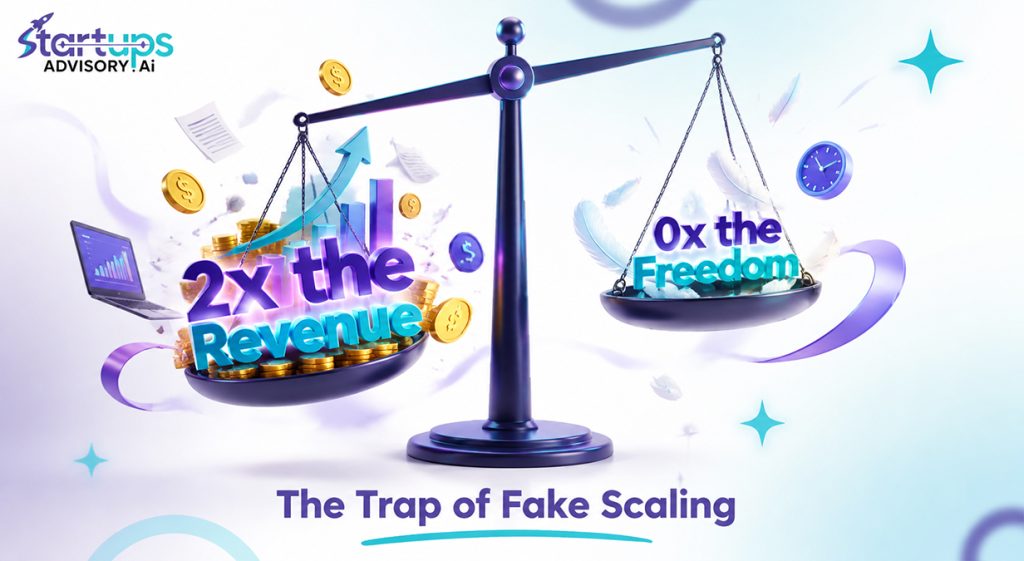
The company grew.
But your freedom did not.
This is the hidden trap many founders discover after growth accelerates: more revenue does not automatically mean more scale.
A business can double its sales while also doubling the workload, complexity, and dependency placed on the founder.
That is the difference between growth and true scaling.
Growth makes the company bigger.
Scale makes the company stronger.
Real scaling means building systems, ownership, and processes that allow the business to handle more demand without requiring the founder’s attention for every decision.
Without that foundation, founders often create something they never intended: a bigger company that still depends on them for every important decision.
That is fake scaling.
Key Takeaways
- More revenue does not automatically mean more scale.
- If every important decision still needs you, growth is increasing dependency.
- Real scaling comes from repeatable systems, ownership and leverage.
- A stronger business should eventually demand less routine founder involvement—not more.
What Does Fake Scaling Actually Look Like?
Fake scaling is growth that makes the company larger without making it stronger.
Six months ago, the founder of a growing service company had a simple goal: win more customers.
The plan worked. New clients arrived. Revenue increased. The team expanded.
But then something unexpected happened.
Every new client created another approval. Every new employee created another question. Every project needed another review.
The company was growing, but the founder had become the system holding everything together
Revenue has grown. But so has almost everything required to produce it.
That is the distinction: hiring and spending are normal parts of growth, but when every additional dollar of revenue requires nearly proportional increases in labor, management or founder involvement, the business is adding capacity without creating enough leverage.
This distinction matters because top-line revenue can hide operational weakness. The warning signs are usually easy to spot: manual processes multiply, margins come under pressure, teams get busier without becoming proportionally more productive, and the founder remains the central point for decisions and information.
Why Can Revenue Grow While Your Freedom Shrinks?
Customers bring revenue, but they also create more operational work, and without the right systems, that extra complexity eventually flows back to the founder.
- More customers: More onboarding, support, billing, reporting, and follow-up.
- More employees: More training, coordination, and management.
- More campaigns: More leads to qualify, route, and pursue.
- More decisions: Questions and exceptions keep returning to the founder.
- More dependency: Important knowledge and approvals stay concentrated in one person.
- More risk: If the operating model is weak, growth magnifies the weakness instead of fixing it.
The real shift is from founder as operator to founder as architect—building a company that can solve routine problems without depending on the founder every time.
In Startup Genome’s early research on high-growth internet startups, 74% of the high-growth companies identified as premature scalers failed. That research is historical and should not be treated as a universal failure rate for every startup today, but its lesson remains useful: accelerating before the underlying model can support acceleration can make problems larger rather than solve them.
What Should Scaling a Business Actually Accomplish?
Scaling a business should make it capable of handling more demand without making the founder proportionally more necessary.
That does not mean creating a completely hands-off company overnight. Especially in an early startup, founders should remain close to customers, product decisions, and important strategic questions.
The goal is different.
Routine work should gradually stop requiring founder-level attention.
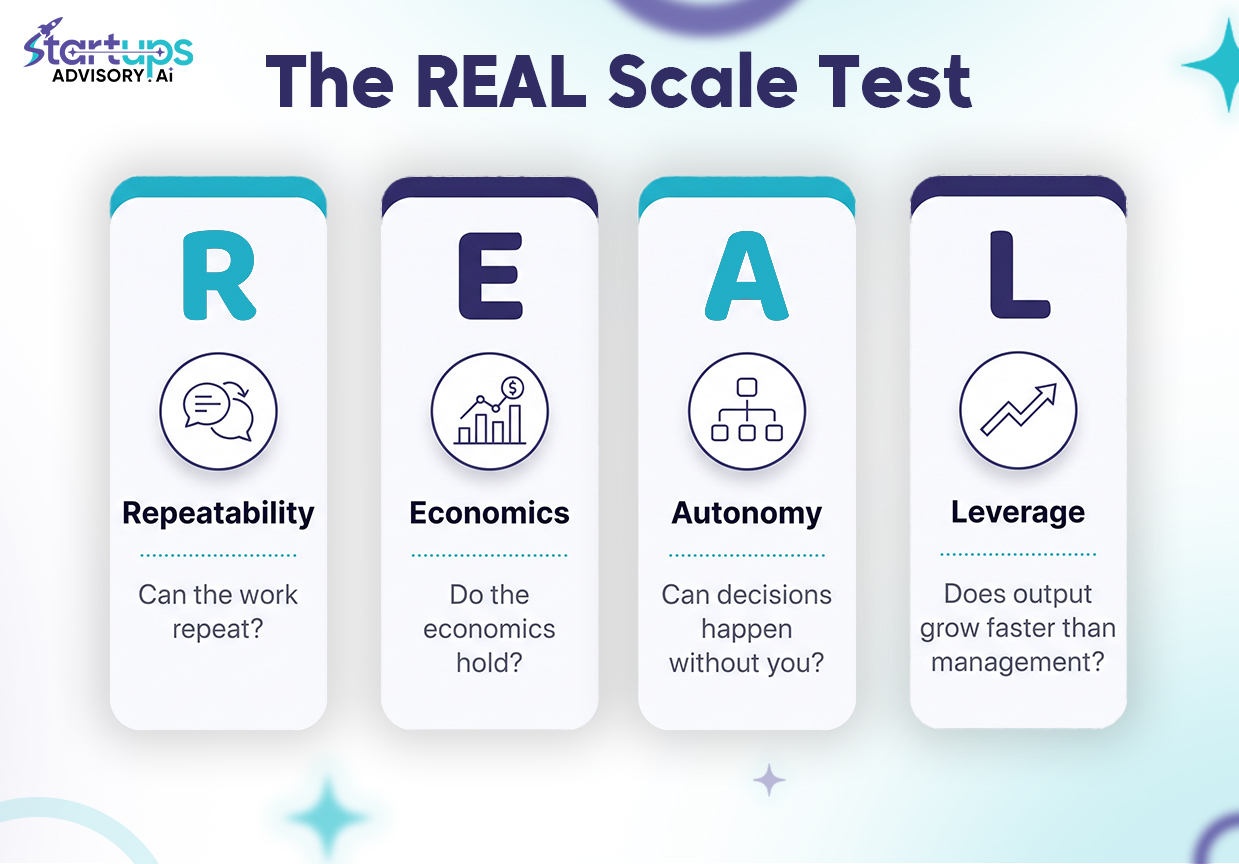
A useful way to judge whether that is happening is the REAL Scale Test.
Consider two founders with similar revenue.
Founder A spends every morning answering customer questions, approving small decisions, and checking team progress.
Founder B reviews weekly results, makes strategic decisions, and lets the team handle daily execution.
Both companies are growing.
Only one is actually scaling
R — Repeatability
Can important work be performed consistently without reinventing the process every time?
Sales follow-up, onboarding, reporting, customer communication, and recurring delivery should eventually follow understandable workflows.
If everything depends on someone remembering what happened last time, the process has not really been built yet.
E — Economics
Does growth improve the business—or simply make it busier?
More sales are valuable when the economics underneath them remain healthy. If every increase in volume demands another expensive layer of people, tools, or firefighting, the company needs to understand why.
Revenue gets attention. The quality of that revenue deserves equal attention.
A — Autonomy
Can people make the decisions their roles require?
Delegation fails when employees receive tasks but not authority.
If someone is responsible for customer follow-up but must ask the founder how to handle every ordinary reply, the task technically moved—but ownership did not.
L — Leverage
Do your people, systems, and technology multiply output, or create more management?
Good leverage lets one decision, process, or system improve many future actions.
That might mean a documented workflow, an automated CRM sequence, a manager who owns an outcome, or a specialist who can execute without being re-briefed every morning.
Fake Scale vs. Real Scale
| Question | Fake Scale | Real Scale |
| What happens when sales increase? | Workload rises almost as fast | Existing capacity absorbs more volume |
| Where do decisions go? | Back to the founder | To the person who owns the outcome |
| How is work performed? | Memory, messages, and improvisation | Clear processes and operating rhythms |
| What does hiring create? | More coordination | More capability |
| What does technology do? | Adds tools | Removes repetitive work |
| What happens to the founder? | Becomes the glue | Becomes increasingly strategic |
The important point is not to chase perfection in every column. Startups are messy. Some founder involvement is healthy and necessary.
You simply want the business to move toward the right-hand side as it grows.
Why Hiring More People Doesn’t Automatically Create Scale
Hiring can relieve pressure, but only when responsibility moves with the work.
Otherwise, the founder simply becomes the manager of the people who were supposed to create freedom. There are more briefs to write, more work to review, more questions to answer, and more context to transfer.
That is the difference between capacity and capability.
Capacity gives you more hands. Capability gives the business more ability to operate without requiring additional founder attention every time.
The same applies to delegation. Telling someone to “send this email,” “update this spreadsheet,” or “show me before it goes live” transfers the task but keeps the thinking with the founder.
Better delegation defines the outcome, guardrails, and authority.
Instead of saying, “Follow up with these leads,” define when follow-up happens, what messaging can be used, what the person can decide independently, and what genuinely needs escalation.
That is when delegation starts creating scale: the founder is no longer transferring only labor. They are transferring ownership.
Michael Gerber’s E-Myth philosophy makes the distinction especially clear: the goal is to build a business that can consistently produce results without depending on the owner to personally deliver them.
As Gerber memorably wrote,
“If your business depends on you, you don’t own a business—you have a job.”
Build the Business Before You Accelerate It
A beginner founder does not need a giant operations manual or dozens of automations.
Start with the work that repeats.
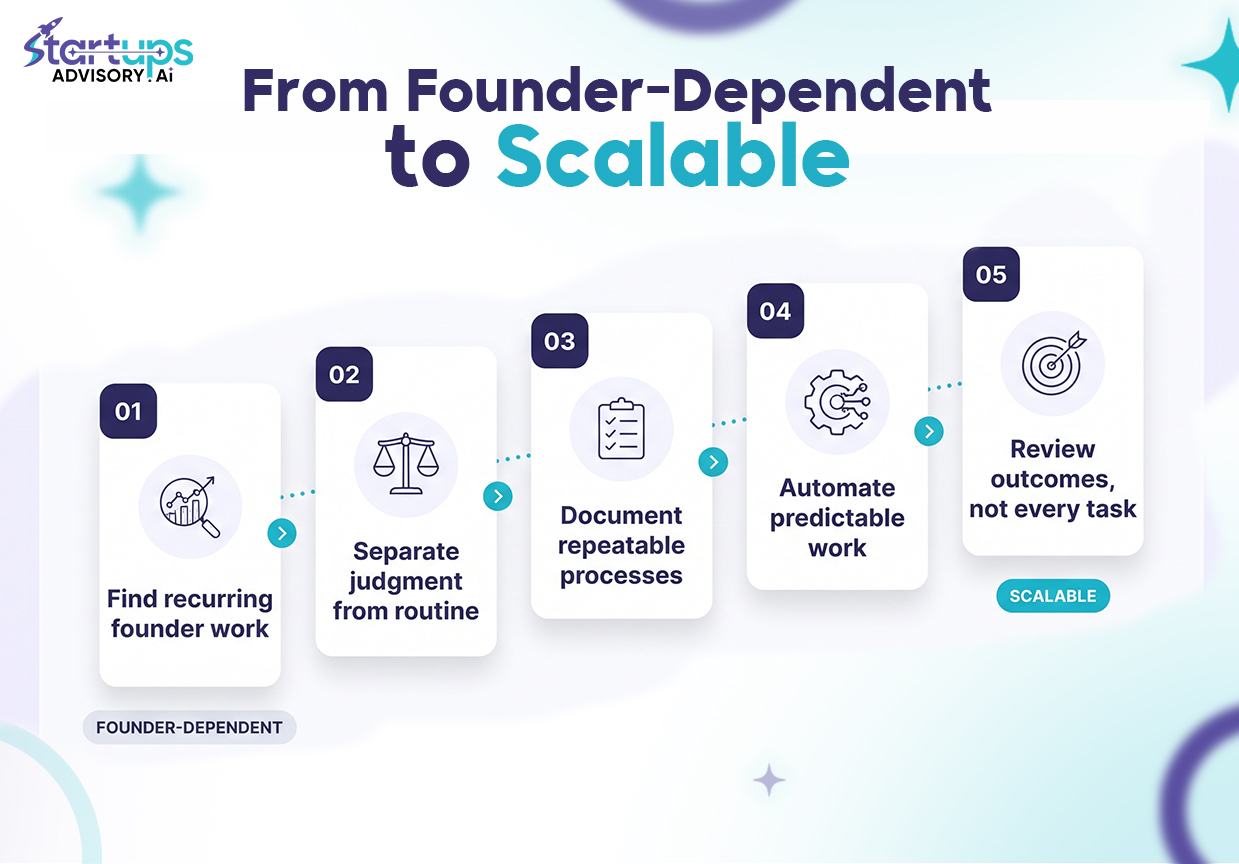
1. Find What Keeps Returning to You
For several days, notice what repeatedly lands back on your desk.
Approvals? Customer questions? Lead follow-ups? Reporting? Scheduling? Content? Vendor coordination?
Those recurring interruptions reveal where the business still depends on you.
2. Decide What Actually Requires Founder Judgment
Some work genuinely belongs with the founder: major positioning decisions, key hires, strategic partnerships, sensitive customer relationships and important capital decisions.
A routine calendar change probably does not.
Separate high-value judgment from routine execution.
3. Document the Repeatable Parts
Do not document everything for the sake of documentation.
Document the processes that repeatedly create confusion, delay or founder involvement.
A useful process answers a few basic questions: What starts the work? Who owns it? What does “done” look like? What can be decided without escalation?
4. Automate the Predictable Work
Automation works best when the underlying decision is already clear.
CRM updates, reminders, recurring reports, simple lead routing, scheduling, and repetitive administrative workflows are often better candidates than nuanced decisions involving customers, positioning, or high-stakes judgment.
Automating a messy process simply makes the mess move faster.
5. Review Results Instead of Touching Every Task
As systems mature, founders should increasingly review outcomes and exceptions, not every action.
That is a major shift.
You still maintain visibility. You simply stop being part of every workflow required to create it.
The Mistakes That Make Growth Feel Like a Trap
- Several mistakes tend to appear when a company starts moving faster.
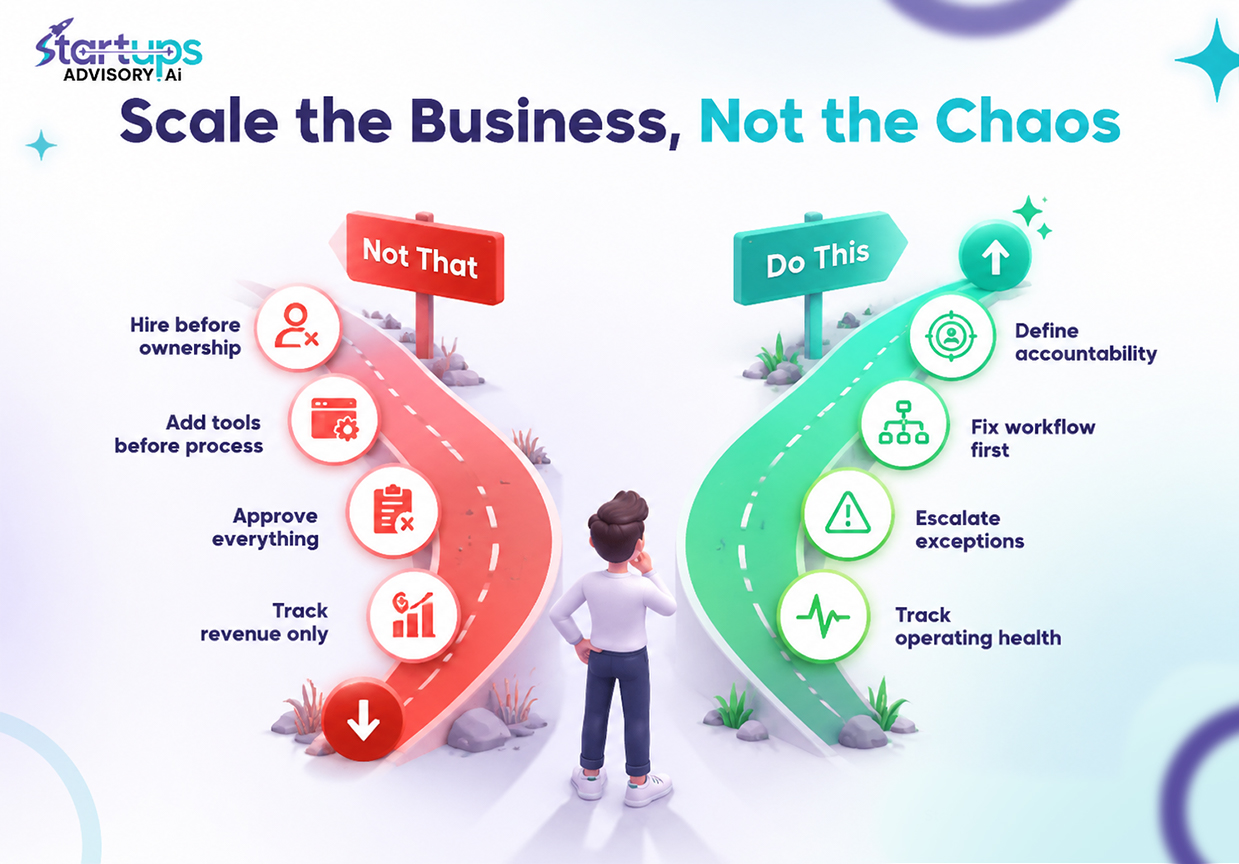
- Hiring before clarifying ownership. You end up with more people but the same decision bottleneck.
- Buying tools before fixing workflows. Software cannot clarify a process nobody understands.
- Keeping every important relationship founder-owned. Customers learn that the only way to get a real answer is to reach the owner.
- Confusing visibility with involvement. You should know what is happening without participating in every step.
- Using revenue as the only scoreboard. Revenue tells you that customers paid you. It does not tell you whether the company became easier or harder to operate.
What Real Scaling Looks Like in Practice
Imagine checking your calendar six months from now.
The company has more clients than ever. Revenue is higher. The team is bigger.
But instead of spending your morning solving internal problems, you are reviewing growth opportunities, talking to strategic customers, and planning the next stage.
Nothing magical happened.
The company simply stopped requiring you for every routine decision.
Now change the system.
The coordinator receives clear authority over standard client requests. Common delivery processes are documented. Specialists own defined quality standards. Sales follow-up runs through a consistent workflow. Routine reporting is automated. Only genuine exceptions reach the founder.
The team has not necessarily become dramatically larger.
The difference is that the business can now carry more weight without passing all of it upward.
That is what real scaling feels like.
The Best Test May Be What Happens When You Leave
You do not need to disappear for months to discover how dependent the business is on you.
Ask yourself:
- Which decisions would stop?
- Which customers would immediately ask for me?
- Which tasks would sit unfinished?
- Which employees would not know what they were allowed to decide?
- Which process works only because I remember how it works?
Those answers are your scaling roadmap.
The goal is not for the business to stop needing your leadership. It is for routine operations to stop requiring your presence.
Growth Should Give the Founder Better Problems
A founder should not expect growth to eliminate difficulty.
Bigger businesses still have difficult customers, hiring decisions, changing markets and new risks.
The difference is which problems deserve the founder’s time.
At the beginning, you may spend Tuesday fixing a broken follow-up sequence.
Later, Tuesday should be spent deciding which market to enter, which partnership to pursue, which product to build, or which strategic customer deserves personal attention.
That is not working less because ambition disappeared.
It is working at a different level because the business finally developed an operating layer beneath you.
From Founder Dependency to Founder Leverage
A growing company eventually reaches a point where effort alone stops working.
The founder cannot be the person who:
- approves every decision
- manages every project
- reviews every deliverable
- coordinates every specialist
The next stage requires an operating layer.
This is where systems, automation, and specialized execution become important.
StartupAdvisory.ai‘s Growth OS combines dedicated execution support, strategic oversight, specialist teams, and automation to help founders spend less time holding day-to-day work together and more time on the decisions that move the business forward.
Through a combination of strategic oversight, dedicated execution support, specialist teams, and AI-powered workflows, founders can reduce operational friction while keeping control over the decisions that matter most.
Stop Scaling Your Bottlenecks. Scale Your Freedom.
Doubling revenue is worth celebrating—but if every stage of growth requires roughly the same increase in your own workload, the operating model needs attention. More revenue should eventually create leverage, not simply more work for the founder.
Explore StartupAdvisory.ai or reach the team at hello@startupadvisory.ai
FAQs
What is fake scaling in business?
Fake scaling happens when revenue grows, but workload, costs, complexity, and founder involvement rise with it.
What is the difference between growth and scaling?
Growth increases output. Scaling increases output without requiring a proportional increase in resources, management, or founder effort.
How do I know if my startup is scaling too quickly?
Watch for unclear ownership, rising manual work, constant approvals, rushed hiring, and declining operational consistency.
Does scaling mean reducing headcount?
No. Scaling may require hiring, but new hires should increase capability rather than create more management work.
When should a founder delegate?
Delegate when the outcome is clear, the work is repeatable, and someone else can own it within defined guardrails.
What should a founder never delegate completely?
Major strategic decisions, key relationships, sensitive leadership issues, and high-risk business decisions usually need senior involvement.
Can automation solve founder dependency?
Not by itself. Fix the process and ownership first, then automate the predictable parts.
How can StartupAdvisory.ai help an overloaded founder?
StartupAdvisory.ai’s Growth OS combines execution support, strategic oversight, and specialist teams to reduce the coordination burden on founders.
Is StartupAdvisory.ai only for established businesses?
No. Its services are positioned for founders at different stages, from early growth to scaling.