
Your business can be growing and still be getting weaker.
That is the trap many founders discover too late.
Revenue increases. Customers arrive. The team expands. New opportunities appear.
From the outside, it looks like progress.
But growth often creates hidden problems:
Cash gets tighter because expansion requires more resources.
Teams lose focus because every opportunity feels important.
Decisions slow down because more people, tools, and processes are involved.
Eventually, the founder becomes the system holding everything together—not because they planned it that way, but because growth exposed gaps that were invisible when the company was smaller.
A business does not become scalable simply because it gets bigger.
It becomes scalable when it can handle more customers, decisions, and complexity without requiring more founder effort for every step forward.
That requires three foundations:
Cash. Focus. Systems.
Cash creates breathing room.
Focus directs resources.
Systems turn effort into repeatable execution.
Miss one, and growth starts creating pressure instead of progress.
Key Takeaways
- Protect enough operating cash to survive a slow stretch without panic decisions.
- Limit the company to a small number of priorities and make daily work prove its connection to them.
- Build repeatable ownership, workflows, and accountability so the founder stops being the default answer to everything.
- Treat cash, focus, and systems as one operating discipline, not three unrelated projects.
Why Do Good Businesses Still Become Fragile?
Six months ago, the founder thought the biggest challenge would be getting more customers. Instead, growth created a different problem.
Every proposal needed approval. Every client’s question came back to them. Every team decision waited for their input.
The company was moving, but only because the founder kept pushing everything forward.
This is the classic founder bottleneck. The founder becomes the routing layer for decisions, execution, quality control, and follow-up. The company can move, but only while that person keeps moving.
The bigger problem is economic. Founder attention is limited. Every hour spent coordinating routine execution is an hour not spent on positioning, partnerships, major clients, or the next growth bet. The website makes the same distinction: stop making the founder the glue and return that person to strategic decisions.
Cash Is What Gives Your Business Room to Grow
A founder looks at the dashboard and sees a profitable month. Revenue is up. New contracts are signed.
Then payroll week arrives.
A major client payment is delayed. Vendor bills are due. The next growth investment suddenly feels risky.
The problem was never revenue. The problem was timing.
That is why cash flow management must come before aggressive expansion.
A practical starting target for many small businesses is roughly three to six months of operating expenses. The exact reserve should reflect revenue predictability, collection cycles, fixed costs, and access to capital. A recurring-revenue business carries different risk from a young company with irregular sales.
The point is not to worship a single reserve number. The point is to create breathing room before pressure forces reactive decisions later. That breathing room lets leaders choose deliberately instead of reacting from fear every week.

The U.S. Bureau of Labor Statistics reported that 34.7 percent of private-sector business establishments born in 2013 were still operating ten years later. Survival has many causes, but staying power deserves as much management attention as growth.
What Does Cash Discipline Actually Look Like?
Close the books every month. Know cash in, cash out, fixed obligations, receivables, and near-term commitments. Forecast conservatively. Review what happens if sales slow, a major invoice arrives late, or a planned hire costs more than expected.
More importantly, make cash a decision filter.
Before adding another tool, contractor, campaign, office expense, or full-time role, the founder should ask: does this expense support one of the company’s current priorities, and can the business carry it if the expected return arrives later than planned?
That question connects cash directly to business focus.
How Does Focus Protect Cash, Attention, and Execution?
Focus protects cash, team capacity, and founder attention from being spread across work that feels productive but does not materially move the company.
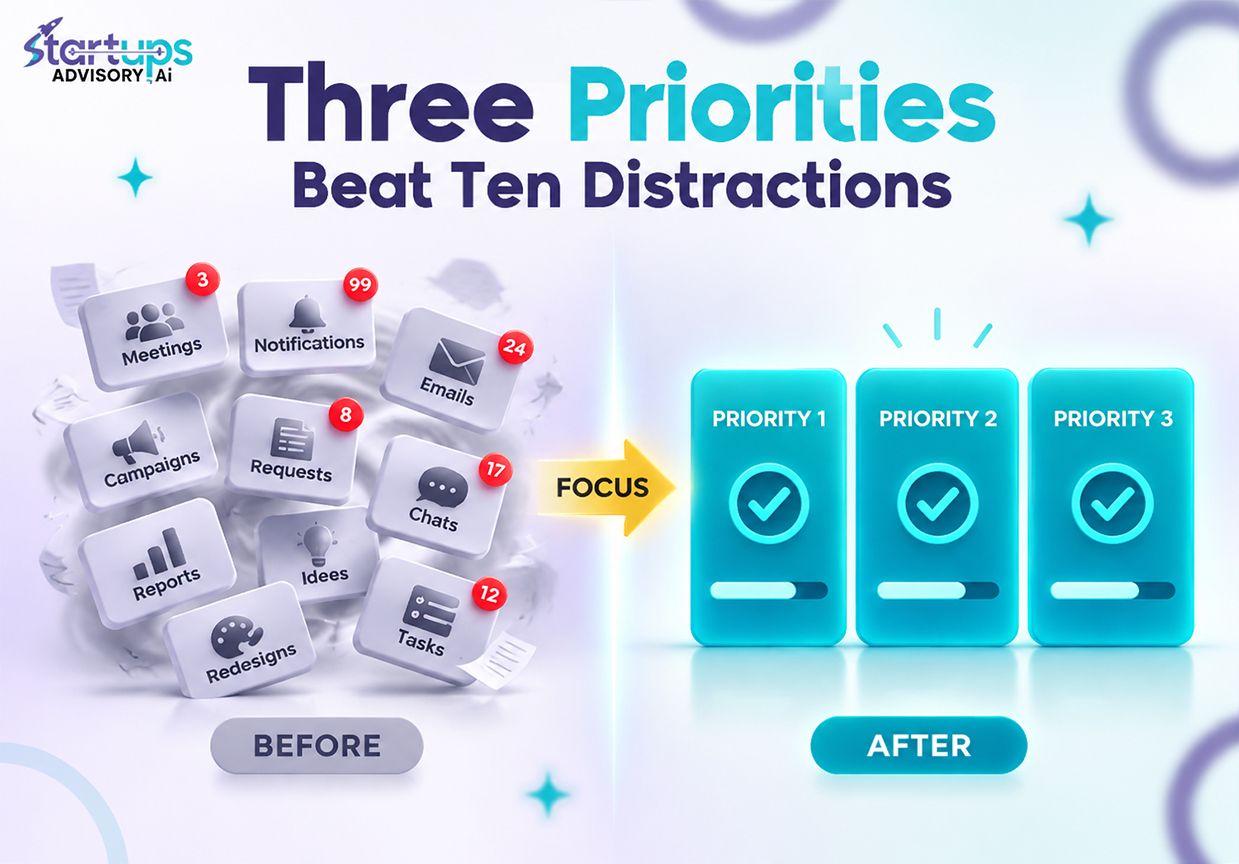
Founders are vulnerable to opportunity overload. A new channel looks promising, someone suggests a podcast, another person wants a redesign, and a campaign gets added before the old one is measured. Soon there is motion everywhere and traction nowhere.
Steve Jobs captured the discipline behind real prioritization:
“Deciding what not to do is as important as deciding what to do.”
A strong business focus model can be deliberately small: choose three major outcomes for the year, translate them into monthly execution cycles, and make active work justify itself against those outcomes.
That does not mean a company only performs three tasks. It means every meaningful initiative has a clear reason to exist.
| Lever | Warning Sign | Better Question | Founder Move |
| Cash | Decisions depend on today’s balance | What can survive a slow period? | Review cash, receivables, and commitments monthly |
| Focus | Too many priorities compete | Which three outcomes deserve resources? | Remove unsupported work |
| Systems | Work waits for founder approval | What moves without the founder? | Assign ownership and accountability |
This is where operational efficiency becomes useful. It is not about squeezing more tasks into each day. It is about reducing wasted coordination, duplicated work, unclear ownership, and constant switching.
Would Your Business Systems Survive a Week Without You?
This is an uncomfortable test.
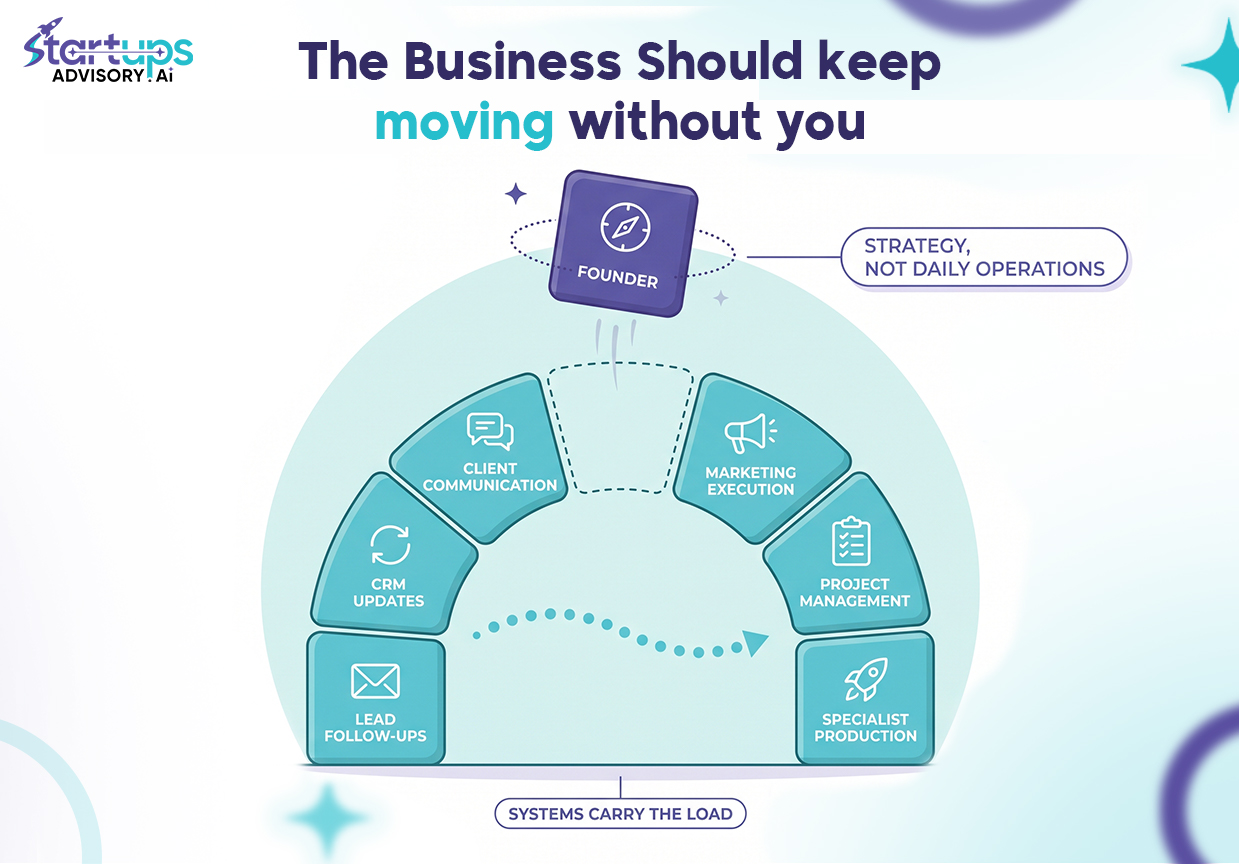
If the company cannot operate for a week without the founder answering routine questions, chasing people, approving standard work, or remembering what happens next, the founder has not escaped the job. The title changed. The dependency did not.
The site makes the same point operationally: routine growth work should move through an execution layer with ownership, while the founder returns to strategic decisions, key relationships, and choices that require founder judgment.
Good business systems are not giant SOP libraries nobody reads. They are clear answers to recurring questions:
Who owns the task? What triggers it? What does complete look like? When does it happen? Where is the information stored? What gets escalated, and what can be decided without the founder?
That structure turns delegation from task assistance into real ownership.
Systems Turn Effort Into Capacity
A business becomes less founder-dependent when routine execution has a rhythm.
Lead follow-up has an owner and timing rule. Social content has a calendar and approval boundary. CRM updates happen inside the workflow. Campaigns have a review cadence. Specialist work reaches the right capability without the founder acting as project manager.
This is where the Growth OS idea becomes relevant. The site combines execution, strategic direction, specialist teams, and automation so the founder can return to CEO-level work instead of coordinating fragmented help.
What Does a Growth OS Actually Provide?
Many founders do not need another isolated tool or another person waiting for instructions.
They need an execution layer that connects strategy with daily action.
StartupAdvisory.ai‘s Growth OS is designed around three levels of support:
- Strategic Direction
A founder needs clarity on what matters most: which growth opportunities deserve attention, which priorities should be removed, and where resources should go.
- Dedicated Execution Support
Instead of the founder coordinating every task, execution moves through structured support that keeps priorities moving, manages follow-ups, and creates operational consistency.
- Specialist Capability When Needed
Growth often requires different skills at different stages. Access to specialized support across areas such as marketing, creative production, web, content, and AI-powered workflows allows companies to execute without building unnecessary internal complexity.
The goal is not to replace the founder’s role.
It is to remove the operational weight that prevents founders from spending time on strategy, customers, and decisions only they can make.
The principle matters more than the label: strategy must connect to execution, execution must have ownership, and ownership must have accountability.
Founder Mistakes That Cost Time, Cash, and Control
Most founders do not intentionally create these problems.
They happen because the decisions that worked at $100k revenue are still being used at $1M revenue.
The founder keeps adding effort instead of rebuilding the operating model.
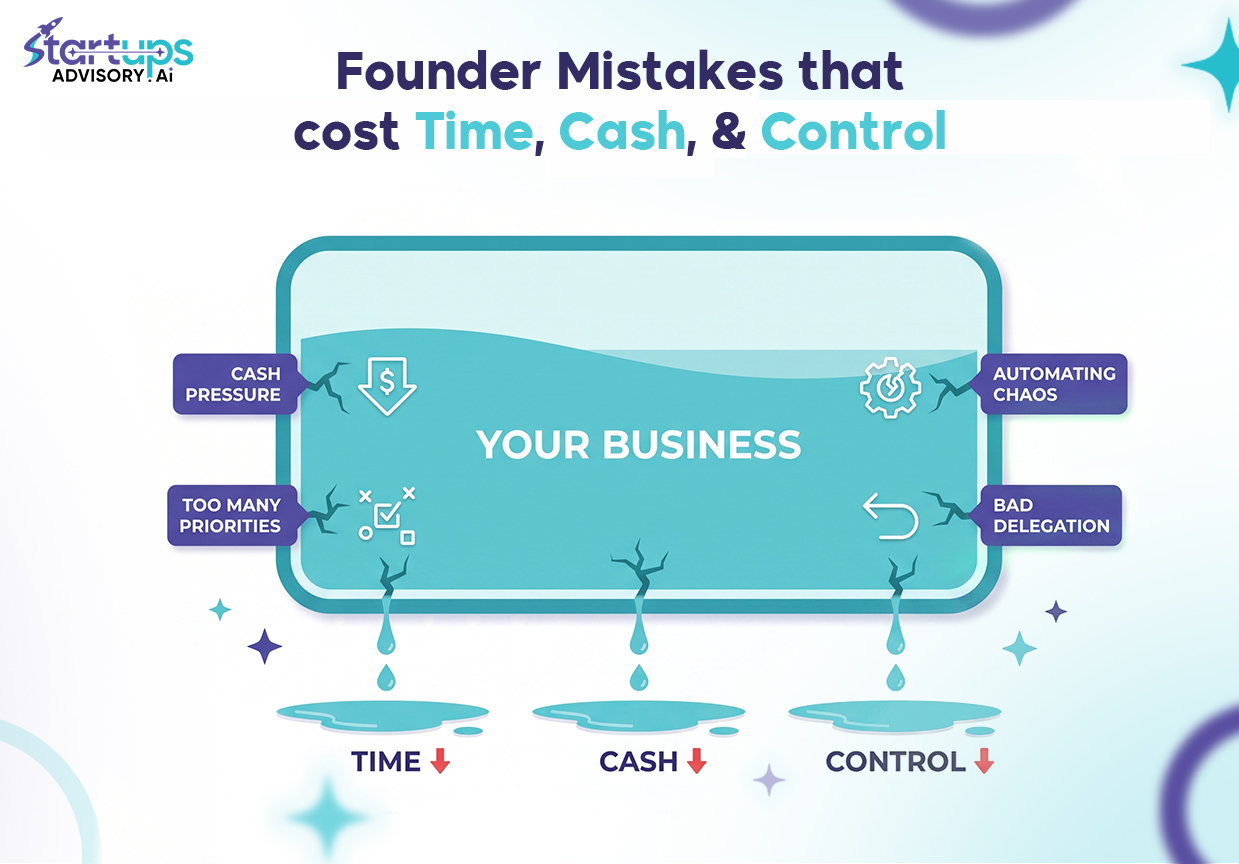
| Mistake | Why It Hurts | Better Approach |
| Treating a cash problem like a sales-only problem | More revenue helps, but weak collections, uncontrolled spending, and poor forecasting can keep cash pressure high. | Improve collections, control spending, and review cash forecasts consistently. |
| Confusing activity with business focus | A busy team can still spend time on work that does not move the company’s most important outcomes. | Limit priorities and make active work clearly support them. |
| Automating chaos | Technology cannot fix an undefined process. It can simply make broken handoffs happen faster. | Simplify the process first, then automate only repeatable, well-defined work. |
| Confusing delegation with dumping tasks | Work handed off without context, standards, or decision rights often creates more founder coordination. | Assign clear ownership, expectations, and decision boundaries. |
| Building without a repeatable rhythm | Even good processes become inconsistent when nobody knows when work happens or how progress is reviewed. | Simplify first, assign ownership second, document the recurring rhythm third, then automate where it removes friction. |
This sequence creates stronger business systems and a healthier operating layer.
The Three Levers That Hold Growth Together
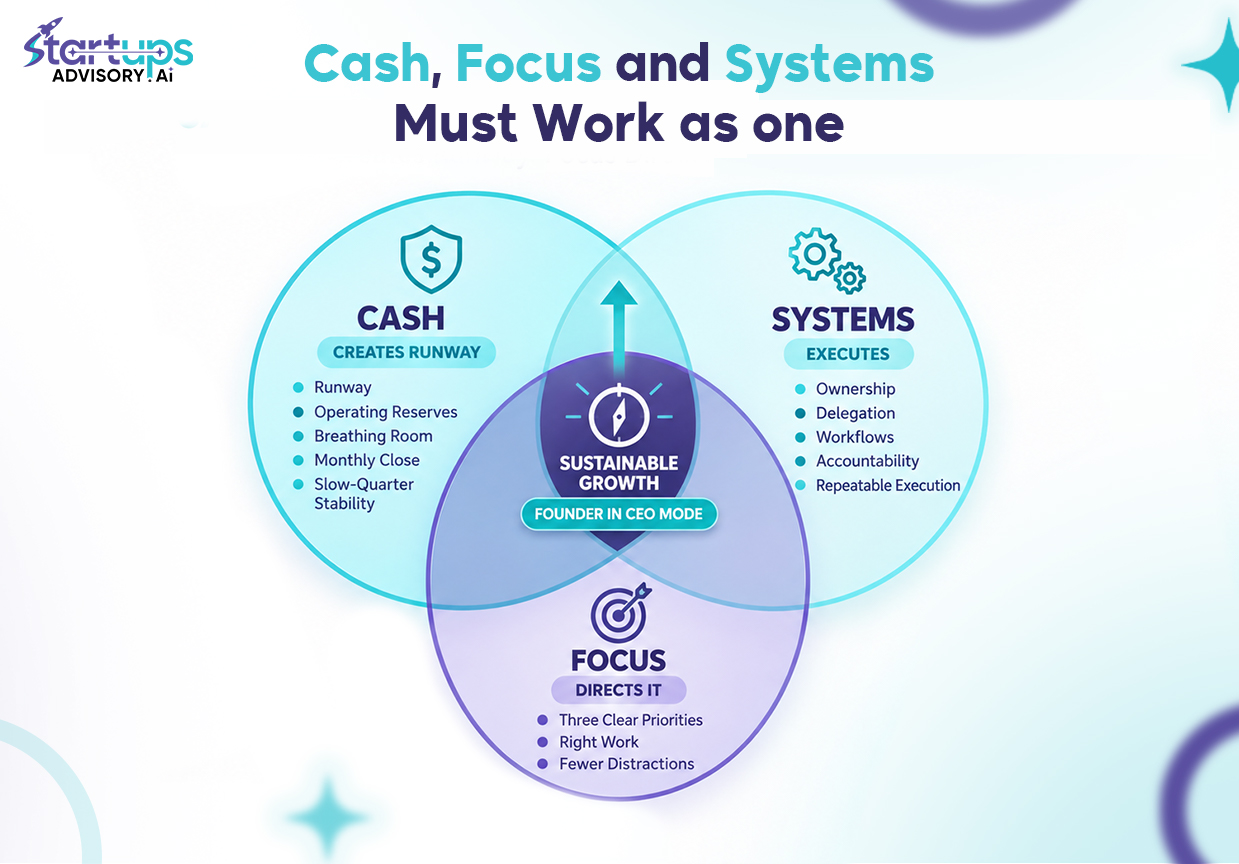
Cash creates a runway. Focus decides where the runway is used. Systems turn the chosen priorities into consistent execution.
They are not separate fixes in practice when growth accelerates.
A company with cash but no focus burns money across too many ideas. A company with focus but no cash may know exactly what matters and still lack time to execute it. A company with cash and focus but weak systems remains trapped by the founder bottleneck because every priority still depends on one person.
The three levers reinforce one another when they share a management rhythm.
At the monthly level, close the books, review cash commitments, evaluate progress against the three priorities, and remove work that no longer deserves resources.
At the weekly level, review execution, blockers, ownership, and decisions that genuinely require founder input.
At the daily level, let the operating layer run. The founder should not have to re-create priorities every morning or personally move every task.
That is what a real business growth strategy looks like when it is translated from ambition into operations.
When Cash, Focus, and Systems Start Breaking Down
A service-business founder starts Monday with decent revenue and a full client pipeline, but by Wednesday the cracks show. A large invoice is still unpaid, the team is working on five different priorities, a campaign cannot launch without founder approval, and two client follow-ups are waiting because nobody clearly owns them.
Nothing looks catastrophic on its own. Together, they reveal all three weaknesses.
Cash is too tight to absorb delay. Focus is scattered across too many initiatives. Systems are weak enough that routine execution still waits for the founder.
Now imagine the same company with a monthly cash review, three clearly defined priorities, and named owners for recurring sales, marketing, CRM, and client work. The founder is still involved, but no longer has to personally push every task forward.
Your Business Should Run on Systems, Not Heroics
Many founders wear overwork like proof of commitment. Early on, the founder may need to sell, deliver, solve problems, and learn what customers value.
But heroics cannot be the permanent operating model.
The goal is not to make the founder irrelevant. The goal is to make the founder valuable in the right places.
A founder should be difficult to replace in vision, major relationships, capital decisions, partnerships, and choices shaping the company’s future. The founder should be increasingly replaceable in routine coordination, repetitive admin, standard approvals, and production management.
That shift improves operational efficiency, but more importantly, it creates capacity for better leadership.
Conclusion: One Weak Lever Can Cook Your Whole Business
Cash, focus, and systems are connected. When one weakens, pressure quickly spreads to the other two.
Without healthy cash flow management, the business loses breathing room. Without business focus, money, time, and attention scatter across too many priorities. Without strong business systems, execution keeps returning to the founder through approvals, follow-ups, coordination, and daily firefighting.
Look at the last month. Did tight cash make normal decisions feel risky? Did too many priorities compete for attention? Did routine work slow down whenever the founder stopped pushing?
Those answers reveal the weakest lever.
Mission matters. Brand matters. Leadership matters. But they become far more powerful when the company has enough cash to breathe, enough focus to choose, and enough structure to execute without everything depending on one person.
The goal is not to remove the founder from the business. It is to remove the founder as the founder bottleneck, creating more room for strategy, major relationships, opportunities, and decisions that genuinely require founder judgment.
Protect the cash. Narrow the focus. Build the systems. Then scale.
For founders who want a stronger execution layer connecting strategy, daily work, specialist production, and automation, Startups Advisory helps build the operating discipline needed to move beyond founder-dependent execution. Visit startupsadvisory.ai, email hello@startupadvisory.ai, or call (877)-408-1285.
Frequently Asked Questions
What makes a good business operating system?
A good operating system connects priorities to owners, workflows, decision rules, reporting, and accountability so important work runs consistently without constant founder supervision.
What are the best practices for managing cash while growing?
Review the books monthly, forecast conservatively, watch receivables, understand fixed commitments, and avoid costs that depend on perfect revenue assumptions. Reserves should reflect actual volatility.
How can a founder improve focus?
Choose a few annual outcomes, translate them into monthly priorities, and require new initiatives to compete against current work. Saying no is part of strategy.
When should a founder hire or delegate?
Delegate when recurring work is clear enough to define, measure, and own. The process should be understandable before responsibility moves.
What services help remove a founder bottleneck?
The most useful support combines execution, strategic oversight, specialist capabilities, and automation rather than forcing the founder to coordinate several disconnected providers.
How can automation support business operations?
Automation works best after ownership and workflow are clear. It can reduce repetitive handoffs, reminders, routing, and admin, but it should support a sound process.
What is the best way to know whether a business can run without its founder?
Watch what happens when the founder steps away from routine work. If standard decisions, client communication, follow-up, reporting, or production stop, the company still has a dependency to remove.
What should a founder fix first: cash, focus, or systems?
Start with the area creating the greatest immediate risk, but do not treat it in isolation. Cash buys time, focus directs resources, and systems preserve execution. Long-term stability requires all three.