
How small business KPIs become useful when a number turns into a decision, an owner, and a next move.
You open your Monday dashboard and see the same red number that was staring back at you last month. Retention has slipped again. Cash is tighter than expected. Leads are coming in, but follow-up is spotty. Everyone on the team call can explain why the numbers look bad, but no one can say what will actually be different by Friday afternoon.
That is the gap between measurement and management. Small business KPIs can show where something is moving, stalling, or drifting, but a red cell on a spreadsheet cannot fix the broken process behind it.
For founders who need an execution layer behind the numbers, StartupAdvisory.ai bridges that gap by combining dedicated growth managers, AI automation, and specialist teams to turn recurring priorities into work that actually gets done.
Key Takeaways
- A KPI becomes useful when it changes a decision or behavior.
- Scoreboard numbers show results; operating signals help explain what is producing them.
- Every important metric needs an owner, a threshold, and a next action.
- The goal is not more reporting. It is faster, clearer follow-through.
The Dashboard Is Not The Decision
Most businesses do not suffer from a lack of data. Accounting software, CRMs, ad platforms, email tools, analytics dashboards, and spreadsheets already produce plenty of it. The problem is what happens after people review the numbers.
Someone says, “That is lower than last month.” Another person offers a possible reason. The meeting moves on. By the next review, the same number is still off track because nobody changed the workflow that produced it.
Tracking answers, “What happened?” Improvement asks, “What will the business do differently because of it?” A KPI is useful only when leaders connect it to a meaningful objective and a decision.
Which Numbers Show The Engine?
The scoreboard-versus-engine idea separates outcomes from the forces creating them. Profit margin and cash on hand tell an owner a great deal about where the business has been. They matter, but by the time those figures look bad, operational problems may already have been building for weeks.
Retention, delegation, and founder hours can offer earlier clues about where the business is going. Customers leaving may point to problems in delivery, communication, or fit. Work that cannot move without the owner may reveal weak ownership. Rising founder hours may show that growth is being bought with personal effort instead of stronger capacity.
That matters in a U.S. small-business environment where owners are still aiming high. In the U.S. Chamber of Commerce Small Business Index for Q2 2026, 66% of small businesses said they expected revenue to increase over the following year.
Optimism helps, but expectations do not create momentum. The operating habits underneath the forecast still have to hold up.
Why Small Business KPIs Go Nowhere
Performance numbers often stall for four basic reasons, shown below.
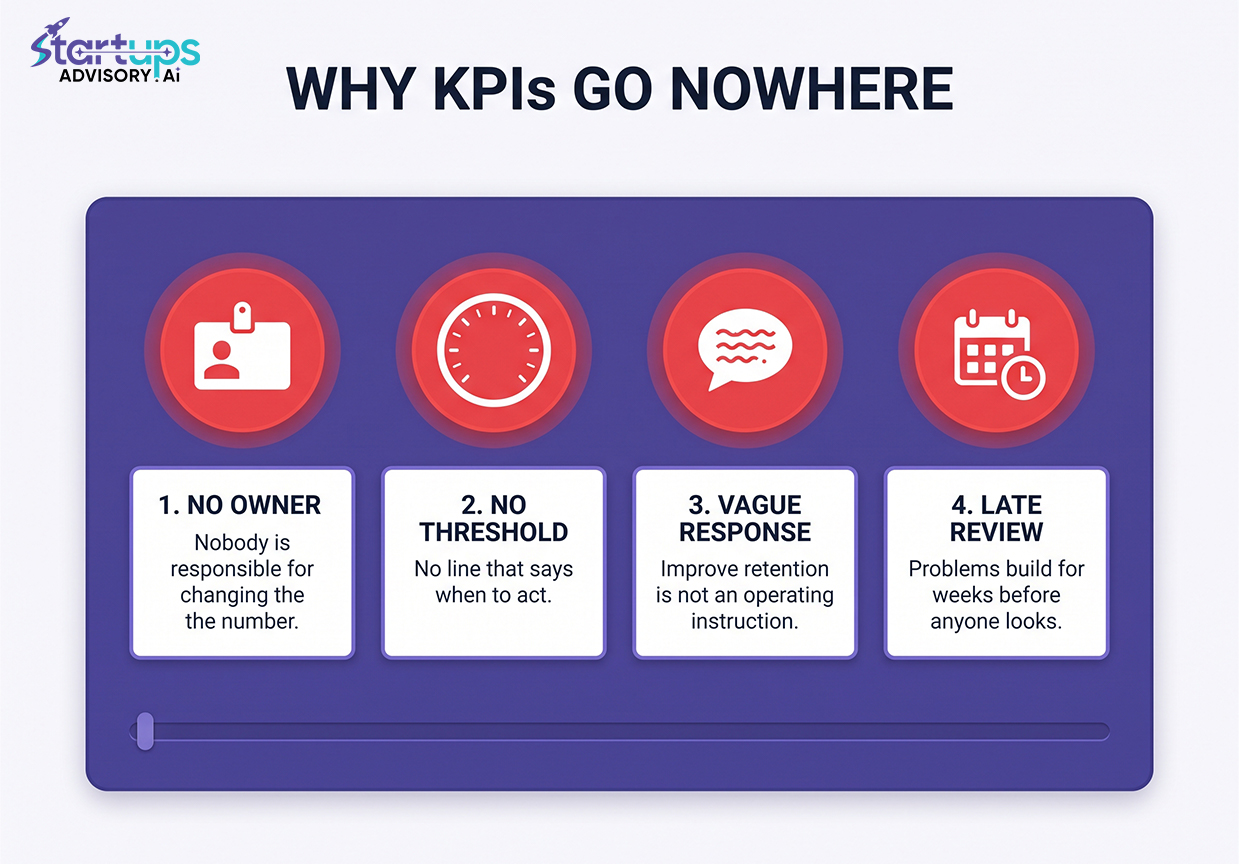
Take customer retention. A founder may know it is falling, but “improve retention” is not an operating instruction. Is onboarding weak? Are customers waiting too long for updates? Are renewal conversations starting too late? Until the business names the likely driver, assigns responsibility, and tests a response, the metric remains descriptive.
The same goes for founder workload. “The owner is working too many hours” will not change until the team identifies what keeps coming back: proposal approvals, client escalations, lead follow-up, scheduling, quality checks, or routine decisions that should have moved down a level months ago.
Numbers rarely need cheering up. Processes do.
Turn Every Signal Into Movement
A practical way to keep metrics from dying in a meeting is to use a five-part loop:
- Notice: Identify the number that moved enough to deserve attention.
- Name: State the most likely operational reason behind the change.
- Assign: Give one person responsibility for the response.
- Act: Make one specific change in the workflow, offer, follow-up, or process.
- Review: Check whether the change moved the number in the intended direction.
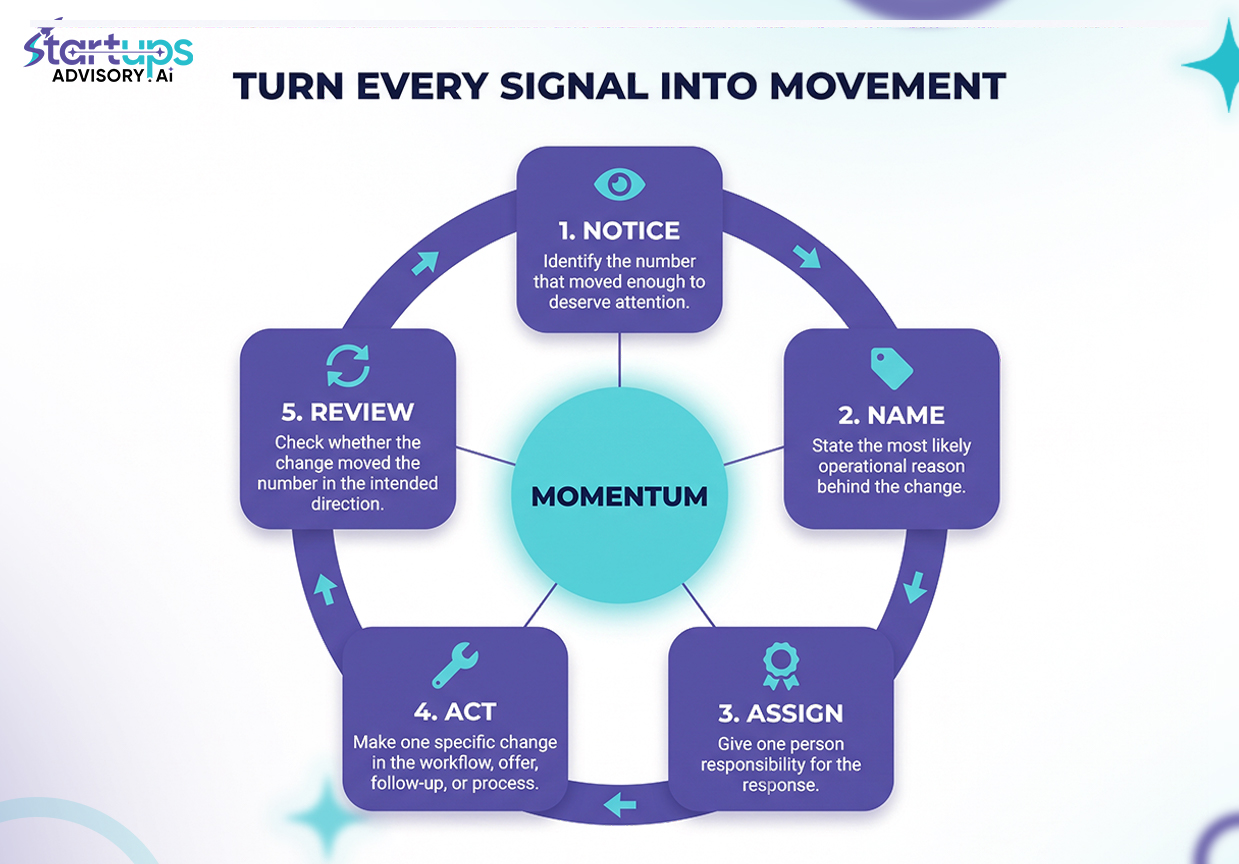
Specificity matters. “Fix follow-up” is fuzzy. “Every qualified lead receives a first response within one business day, and the sales coordinator owns the sequence” is something a team can actually run.
What Should A KPI Trigger?
A strong operating review should connect each important signal to an observable response.
| Signal | What It May Be Saying | A Better Next Move | Clear Owner |
| Retention is slipping | Onboarding, delivery, or follow-up may be weak | Review lost accounts and tighten the weakest handoff | Account lead |
| Cash is tightening | Collections, margins, spending, or timing may be off | Identify the biggest short-term cash pressure | Finance |
| Profit margin is shrinking | Costs may be rising faster than pricing or productivity | Review high-cost work and low-margin offers | Founder or finance lead |
| Delegation is flat | Work is being handed out without real ownership | Move one repeatable function to a named owner with decision rules | Functional lead |
| Founder hours are rising | Too many approvals and routine tasks still climb upward | Remove, automate, or reassign low-judgment work | Founder and operations lead |
The point is to move from “the number changed” to “here is the operating choice that follows.”
Who Owns The Number After Monday?
Shared responsibility can quietly kill momentum. If five people are “keeping an eye on retention,” there is a fair chance nobody is responsible for changing it.
Ownership does not mean one person controls every factor behind the result. It means someone keeps the issue visible, coordinates the response, and brings the next update back to the team. A service company might have an account lead own retention. That person cannot control every customer interaction, but can flag patterns, make sure renewal conversations happen on time, and surface recurring problems.
Can The Team Act Without Permission?
Another snag appears when leaders say they want people to own results, but every adjustment still requires founder approval. A sales manager sees slow lead response but cannot change the cadence. A customer lead notices the same onboarding complaint repeatedly but waits for sign-off before updating the process.
The number is visible. The decision rights are not.
Teams need clear boundaries around what they can change on their own, what requires consultation, and what genuinely belongs with the founder. Otherwise, accountability turns into another version of “wait until the owner gets back to us.”
A Friday Test For Every Metric
At the end of the week, use this question to check whether reviewing a metric led to action.
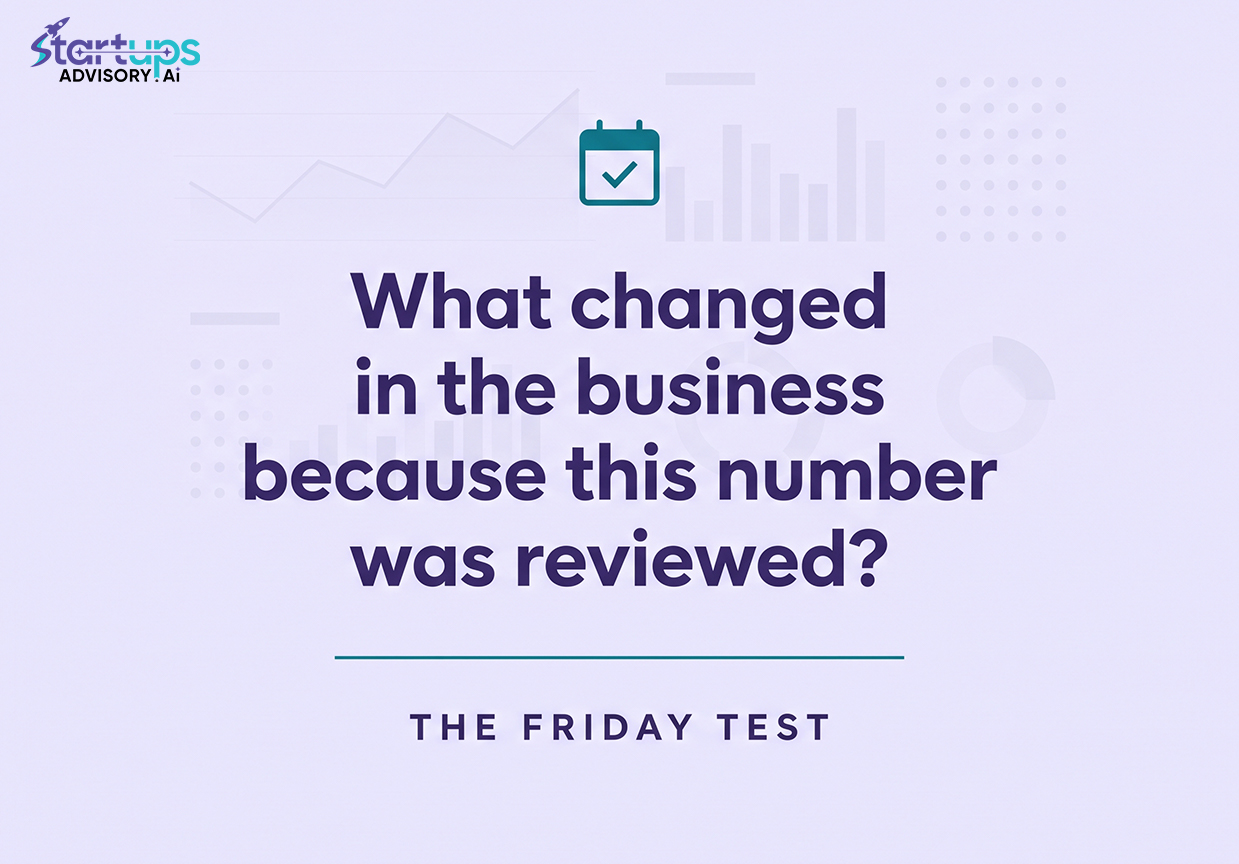
If the same KPI appears in meeting after meeting without producing a decision, the company is probably tracking more than it is managing.
The best reviews end with something concrete: a new follow-up rule, an adjusted offer, a changed handoff, a cost decision, a delegated responsibility, or a workflow that no longer needs founder approval. That is how reporting turns into forward motion.
The Trap Of Measuring Everything
A crowded dashboard can make a business look sophisticated while making priorities harder to see. Website traffic, social reach, ad clicks, pipeline value, cash, margin, churn, email opens, reviews, response times, and a dozen other numbers can all compete for attention.
A better approach is to keep the leadership layer small. Supporting metrics can live in the background, but the team should know which few indicators connect most directly to the current growth priorities.
Do: pair each priority number with an owner and next action.
Don’t: add another chart simply because the data exists.
Do: investigate the workflow behind a missed target.
Don’t: overhaul the business because of one noisy week.
One Busy Business, One Better Habit
Imagine a growing home-services company with plenty of inquiries but uneven bookings. The owner checks the CRM every Monday and sees that booked jobs are not rising as quickly as leads. For months, the team talks about lead quality and seasonality.
Then the review changes. Instead of debating the number again, the team traces what happens after an inquiry arrives and finds that response times become inconsistent when the office gets busy. One coordinator is given ownership of first response, a follow-up sequence is put in place, and the owner no longer checks every open lead personally.
The example is hypothetical, but the pattern is common: the useful moment was not discovering the metric. It was connecting the metric to a process someone could improve.
How Small Business KPIs Build Momentum
The real promise of performance measurement is not better reporting. It is better judgment followed by clearer execution. When a number has a purpose, an owner, a decision threshold, and a review loop, it becomes part of how the company operates instead of something leadership checks after the fact.
Momentum comes from closing that loop again and again: see the signal, name the issue, make a choice, assign the work, and come back to see what happened. Over time, the business gets faster at correcting small problems before they turn into expensive ones. The numbers stop acting like a rearview mirror and start helping the team steer.
For founders who need more execution behind the numbers, StartupAdvisory.ai provides a Dedicated Growth Assistant, Key Growth Manager, specialist growth teams, CRM and outreach support, digital marketing execution, and AI automation designed to keep priorities moving instead of leaving them trapped in reports.
Turn the next KPI review into the next move. Visit the website, email hello@startupadvisory.ai, or call (877)-408-1285.
FAQs
Why can a performance number stay stuck?
Because visibility alone does not change the process producing the result. Someone still has to identify the likely cause, choose a response, and follow through.
What makes a metric actionable?
It needs a clear purpose, an expected range or threshold, a named owner, and a decision that follows when performance moves outside that range.
How should teams handle a missed target?
First, check whether the change is meaningful, then investigate the operational driver before jumping to a solution. The response should be specific enough to test.
Can automation improve operating results?
It can help with repeatable work such as reminders, routing, follow-up, reporting, and data updates when the underlying process is already clear.
What is a custom performance review?
It is a review built around the company’s goals, business model, and constraints rather than a generic dashboard. The useful indicators are the ones tied directly to decisions the team can make.