Your first customers did not choose you because you had the biggest team.
They chose you because you moved differently.
While larger companies were still discussing AI strategies, your team was already shipping. You tested faster, launched features quicker, and built things that would have taken months before AI changed the game.
For a while, speed felt like your unfair advantage.
Then the market caught up.
The same tools that helped you build faster became available to everyone else. A competitor launched a similar feature. A new startup appeared with almost the same promise. What once looked like innovation started becoming an expected feature.
Nothing was wrong with your technology.
The problem was that technology alone was no longer enough.
AI removed the barrier to building.
It did not remove the challenge of building something customers cannot easily replace.
The next generation of AI companies will not win because they found a better model.
They will win because they built advantages that models cannot provide:
deeper workflows, proprietary knowledge, customer trust, distribution, and systems that become more valuable with every use.
Key Takeaways
- Cheaper AI makes experimentation easier, but it also makes basic AI features easier to copy.
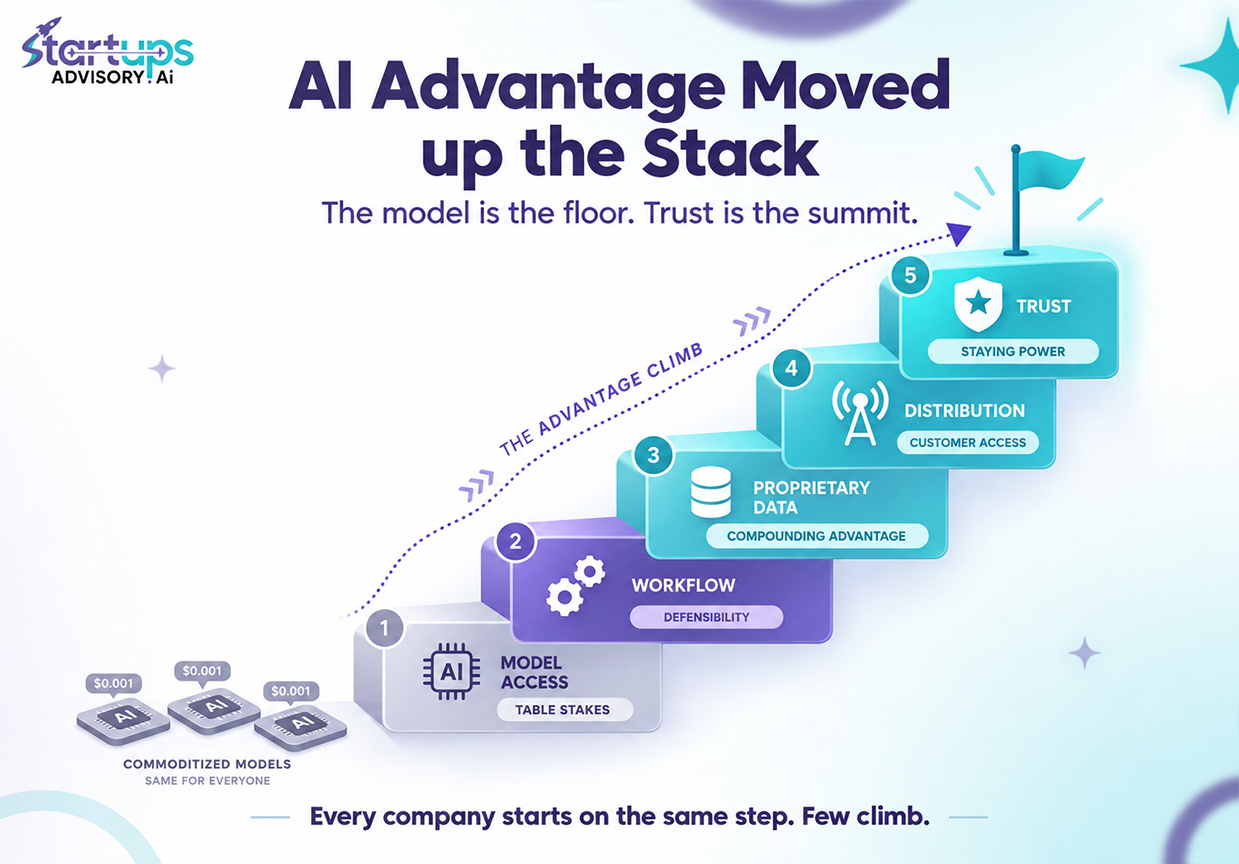
- Model access is increasingly a starting point, not a durable business moat.
- Durable differentiation comes from workflow depth, proprietary data, distribution, trust, and switching costs.
- Founders should ask what becomes stronger every time a customer uses the product.
If Everyone Has the Same AI, Who Actually Stands Out?
For years, sophisticated AI required scarce talent, infrastructure, and capital. That scarcity itself created an advantage.
Foundation models changed the equation.
A small team can now rent powerful capabilities rather than build them from scratch. Stanford HAI found that the cost of querying a model performing around GPT-3.5 level fell from $20 per million tokens in November 2022 to $0.07 by October 2024, a more than 280-fold reduction in roughly 18 months.
That is excellent news for builders.
It is uncomfortable news for anyone whose entire AI startup moat is access to the technology.
When capability becomes cheaper and broadly available, competitors can launch faster, model providers can absorb popular features, and customers gain more alternatives. A feature that looked differentiated six months ago can quickly become expected.
The Model Is Becoming the Starting Line, Not the Moat
Calling every AI application a “wrapper” oversimplifies the problem.
A thin interface around a public model can certainly be fragile. But the weakness is not that the business uses someone else’s model. Nearly every software company relies on infrastructure it does not own.
The real issue is whether anything valuable exists beyond the model call.
Research on AI defensibility has long pointed toward workflow integration, accumulated operating knowledge, proprietary data, switching costs, network effects, and trust. When AI becomes embedded in a customer’s actual process, the product can become much harder to replace even if the underlying model changes.
Peter Thiel’s deliberately provocative line, “Competition is for losers,” is useful here. His broader point is that copying what everyone else is already doing makes it harder to build something genuinely distinct.
In AI, copying has simply become much faster.
What Happens When the Model Provider Copies Your Feature?
One of the biggest risks for an AI startup is building its entire value proposition around a capability that the underlying model provider can eventually offer directly.
That pressure can come from both directions. Foundation-model companies continue adding features to their own platforms, while open-source models make similar capabilities available to more developers. A startup sitting between those two forces can quickly lose differentiation if its only advantage is a cleaner interface around the same intelligence.
This does not mean every AI wrapper is doomed. It means the product needs to own something the model provider does not automatically inherit.
That could be a workflow deeply embedded inside a customer’s business, proprietary data generated through usage, specialized domain knowledge, integrations across multiple systems, trusted relationships, or distribution into a specific market.
Greylock makes a similar point in its discussion of modern AI moats: when underlying technology becomes more accessible, value can move into adjacent layers such as workflows, integrations, data, brand, trust, network effects, and go-to-market execution.
The founder test is straightforward:
If a major model provider launches your core feature tomorrow, what part of the business would customers still need from you?
If the answer is “not much,” the company has a feature advantage.
If the answer includes customer context, operational integration, trusted execution, data, or distribution, the business is starting to build something much harder to erase.
What Actually Creates an AI Competitive Advantage?
Imagine two founders who launch almost identical AI products on the same day.
Six months later, one company is struggling because customers can leave with almost no friction.
The other company has become deeply embedded into daily workflows, collected customer-specific knowledge, and built a reputation inside its niche.
Both started with similar technology.
Only one built an advantage
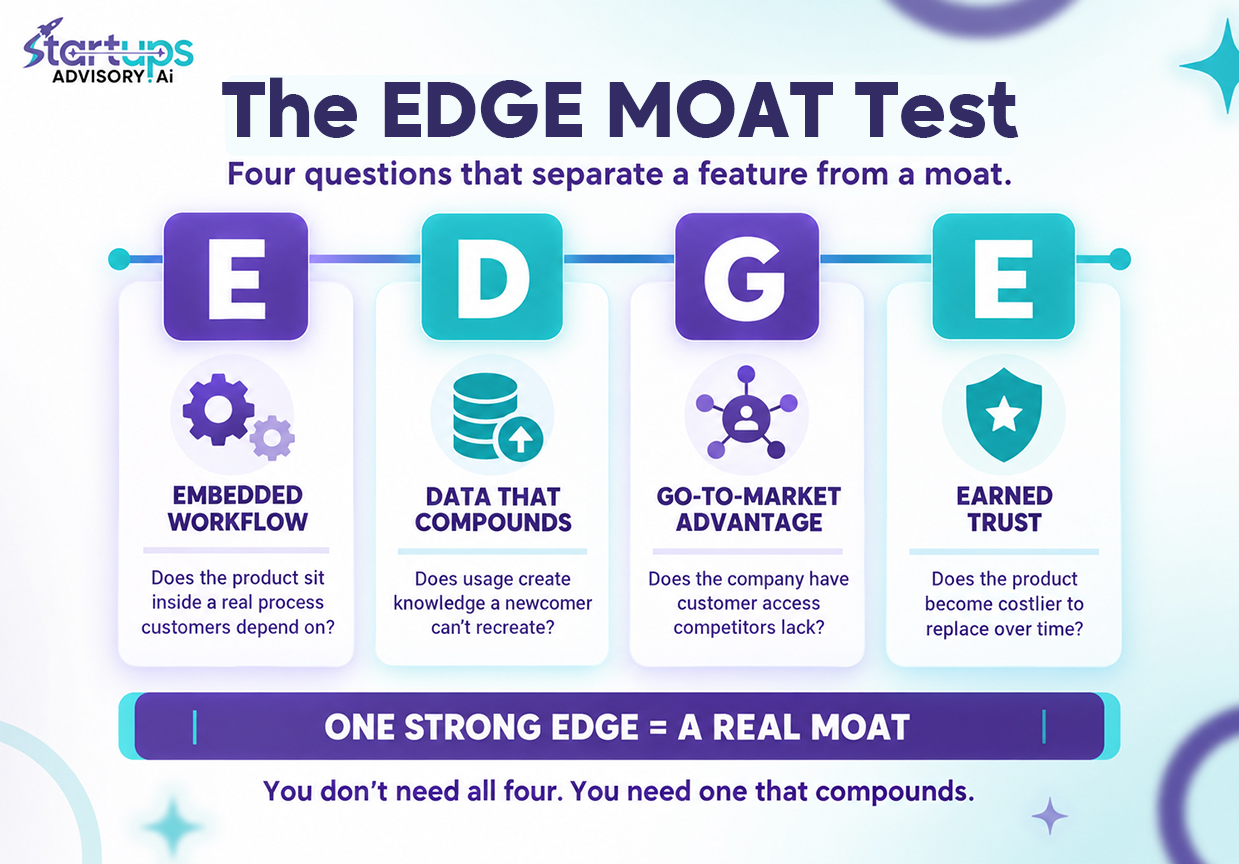
A useful test is the EDGE framework:
E — Embedded workflow: Does the product sit inside a real process customers depend on?
D — Data that compounds: Does customer usage create information, feedback, or operating knowledge a newcomer cannot instantly recreate?
G — Go-to-market advantage: Does the company have a distribution channel, niche expertise, partnership network, audience, or customer access that competitors lack?
E — Earned trust: Does the product become more credible, reliable, integrated, or costly to replace over time?
| Layer | Weak Position | Defensible Position |
| Product | AI feature anyone can reproduce | End-to-end outcome |
| Data | Public information only | Proprietary feedback and context |
| Workflow | Standalone tool | Embedded daily process |
| Distribution | Competing for the same clicks | Owned channel or niche access |
| Trust | “Powered by AI” | Proven reliability and customer confidence |
A strong AI differentiation strategy does not need every moat immediately. It needs at least one advantage that becomes more difficult—not easier—to copy as the business grows.
Do This, Not That: Building a Stronger AI Business
Cheap building can create a dangerous kind of confidence. A founder can ship quickly and mistake speed for defensibility. The most common traps usually come down to three choices:
| Do This | Not This |
| Sell the outcome and embed it into the workflow. Focus on the customer result, then make the product useful inside a process they depend on. | Do not sell the model or rely on a copyable feature. Customers care about the job getting done, not which model sits underneath it. |
| Build distribution alongside the product. Create a repeatable path to customers through partnerships, niche reach, audience, or sales systems. | Do not wait until launch to think about distribution. A technically superior AI product can still disappear if nobody knows it exists. |
| Use AI where it creates real leverage. Apply it to problems where intelligence, automation, or context genuinely improves the outcome. | Do not treat prompts or unnecessary AI as the moat. Prompt improvements can be copied, and adding AI to a problem that simpler software could solve creates novelty rather than defensibility. |
The better move is to ask what the company is building and accumulating over time while competitors are simply shipping features.
Everyone Has a Model. Not Everyone Has the Edge.
Consider two hypothetical companies serving the same professional-services niche.
Both build on comparable foundation models.
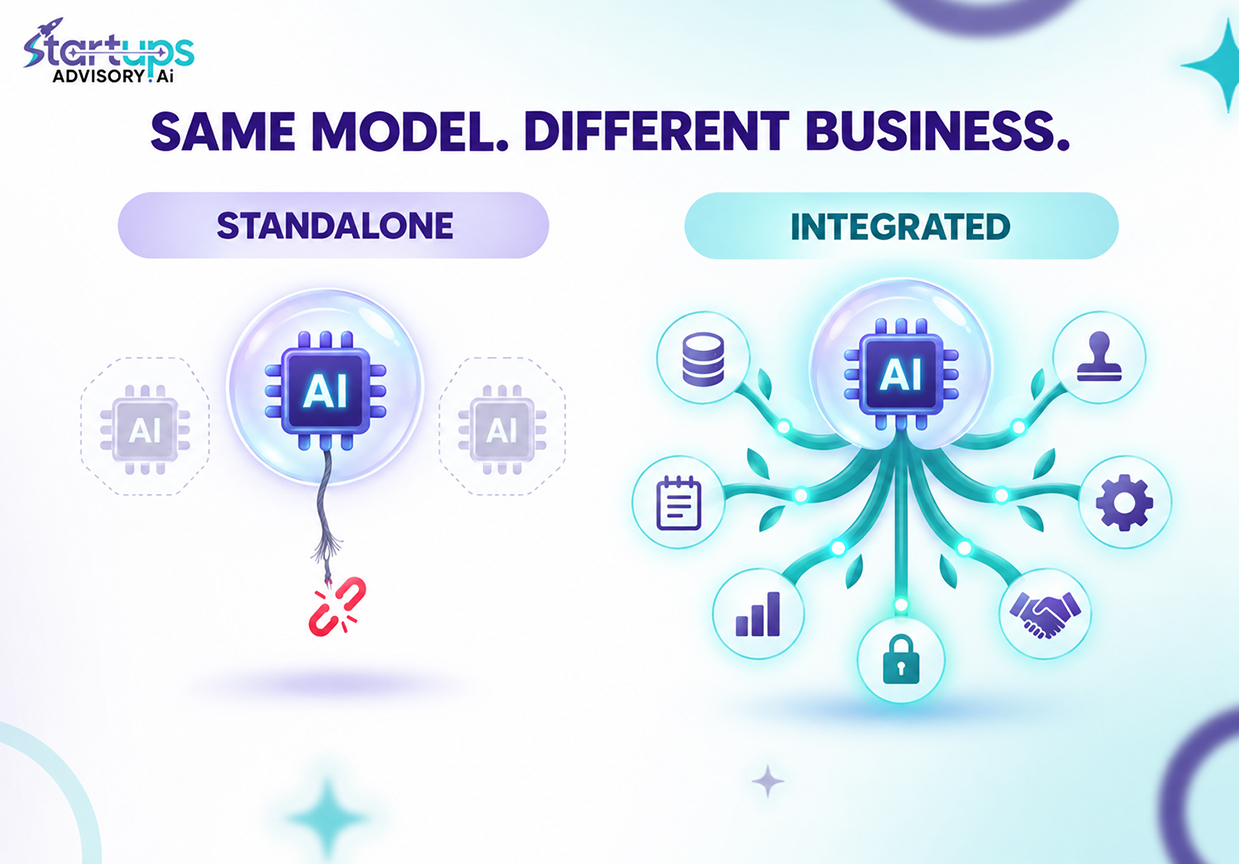
The first launches a polished assistant that summarizes documents and drafts responses. Customers like it. But another company can reproduce most of the experience quickly, and switching requires almost nothing.
The second starts with a similar AI capability but keeps going. It connects into the customer’s CRM, learns approval rules, captures corrections, remembers account-specific preferences, fits existing reporting routines, and develops a distribution partnership inside that niche.
After a year, the AI model may no longer be the interesting part.
The workflow integration, customer context, feedback history, relationships, and accumulated trust are.
That is the difference between using AI and building a company around AI.
The Real Advantage Compounds While the Model Commoditizes
A strong AI business should become more valuable as customers use it.
That is an important distinction.
A basic feature can remain almost identical on day one and day one hundred. But a defensible product should accumulate something: customer preferences, workflow history, corrections, industry context, integrations, operating knowledge, relationships, or distribution strength.
That accumulation creates distance between the company and a new competitor.
Consider a generic AI assistant that drafts proposals. A competitor can reproduce the basic drafting function relatively quickly. But if the product gradually understands how a specific company prices work, structures approvals, handles exceptions, follows up with prospects, integrates with its CRM, and learns from completed deals, the value has moved far beyond text generation.
The underlying model may even become interchangeable.
The business context is not.
This is why proprietary data and feedback loops matter. The supplied research notes that AI products can become more defensible when usage generates data and feedback that improve the experience over time, while deeper workflow integration can also increase switching costs.
Founders should therefore ask a different growth question:
What does the company own after serving its hundredth customer that it did not own after serving its first?
If the answer is only revenue, the moat may still be thin.
If the answer includes better data, deeper integrations, stronger trust, richer operating knowledge, and easier customer acquisition, the business is beginning to compound.
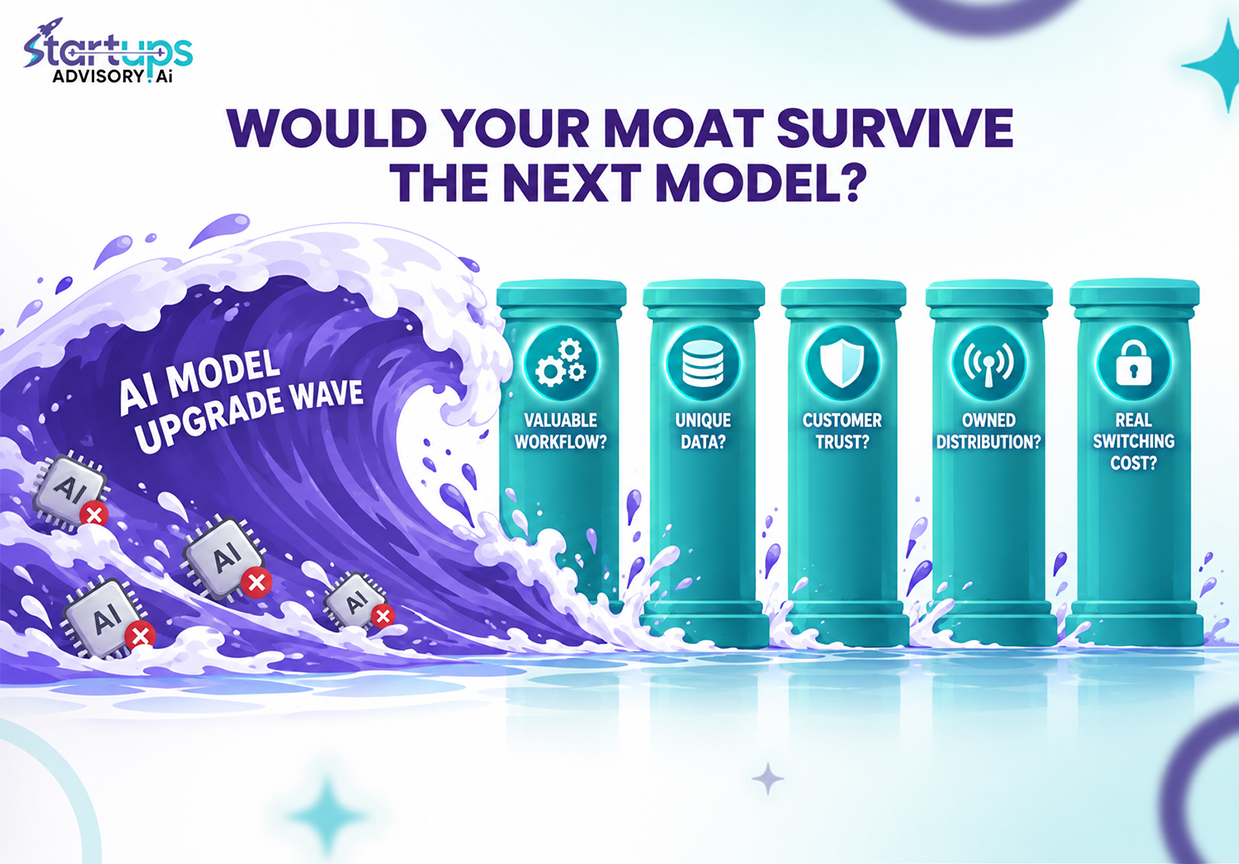
Does Your Advantage Survive the Next Model Release?
This may be the most useful founder test in the article.
Imagine tomorrow’s foundation model becomes cheaper, faster, and substantially better.
Then ask:
- Would the product still own a valuable workflow?
- Would customer-specific data and feedback still matter?
- Would users still have a reason to trust this company?
- Would distribution still bring customers competitors cannot easily reach?
- Would switching still require customers to give something meaningful up?
If every advantage disappears when the underlying model improves, the company probably has a technology head start, not a durable business moat.
Turning AI Strategy Into Execution
Having the right AI strategy is only the beginning.
Founders still need execution systems that connect priorities, people, workflows, and automation.
StartupAdvisory.ai helps startups build that operating layer by combining strategic guidance, specialist execution, and AI-powered workflows.
The goal is not simply adopting more AI tools.
The goal is building a company where technology, people, and processes work together to create measurable growth.
Conclusion: AI Is the Tool. The Moat Is Everything Around It
The AI bubble argument gets easier to understand once technology and business quality are separated.
Some AI companies will disappear. Some features will be absorbed into larger platforms. Some products will become commodities as models improve.
None of that means AI itself lacks lasting value.
It means access to AI is becoming less useful as an AI competitive advantage.
The stronger question is what remains after everyone receives the same technological upgrade.
Workflow. Data. Distribution. trust. Customer relationships. Operating knowledge. Switching costs. Execution.
Those are slower to build—which is precisely why they matter.
The model can be rented. The advantage has to be earned.
For founders who want strategy, execution, specialist capability, and AI automation working as one accountable operating system rather than a pile of disconnected tools, Startups Advisory helps move the founder out of coordination and back into higher-leverage growth work. Visit Startups Advisory, email hello@startupadvisory.ai, or call (877)-408-1285.
Frequently Asked Questions
What makes a good AI startup moat?
A strong AI startup moat is an advantage competitors cannot quickly recreate, such as proprietary data, embedded workflows, distribution, trust, network effects, or meaningful switching costs.
What are the best practices for AI differentiation?
Start with a painful customer workflow, then build data, integrations, feedback loops, trust, and distribution around the solution rather than relying on model access alone.
Are AI wrappers automatically bad businesses?
No. A thin wrapper with no additional value is vulnerable. A product built around deep workflow ownership, customer context, distribution, or proprietary data can still become highly defensible.
How can founders build an AI competitive advantage?
They should identify what improves as customers use the product: data, workflow depth, operating knowledge, customer relationships, brand trust, or network effects.
When should a founder worry about commoditization?
When competitors can reproduce the core customer value quickly by accessing the same model or when a model provider can absorb the feature without disrupting the customer’s workflow.
What role does distribution play in an AI business moat?
Distribution determines whether the company has a repeatable path to customers. A strong channel, niche community, partnership network, or audience can remain valuable even when technology becomes widely available.
Can workflow integration create switching costs?
Yes. When a product becomes connected to data, approvals, reporting, team routines, and systems of record, replacing it can require significant operational change.
What is the simplest test for AI defensibility?
Ask what happens when the next model becomes cheaper and better. If the company’s advantage disappears, it likely had a head start rather than a moat.