You are sitting in a meeting with one of your biggest customers. They are frustrated because a decision made last week created a problem that affected their business. The response they received was technically correct. The process was followed. The data supported the recommendation.
But the customer does not care about any of that.
They want to know why the decision happened. They want to know what your company is going to do next. They want someone to take responsibility.
And that is the moment every business using AI eventually has to face.
The system can explain the recommendation. It can show the data behind the decision. It can even complete the task that created the situation.
But it cannot sit across from the customer.
It cannot protect the relationship.
It cannot accept responsibility for the consequences.
The business still has to.
That is the one advantage AI cannot replace: ownership of the outcome.
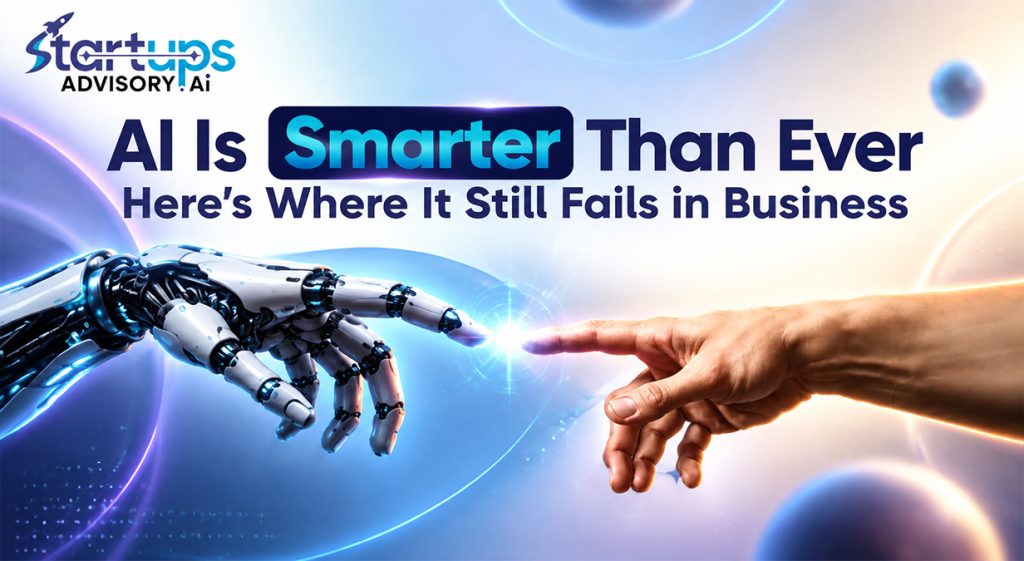
AI is becoming incredibly capable. It can write, analyze, automate, research, code, and execute workflows faster than most traditional systems ever could. But business is not just a collection of tasks waiting to be completed.
Business is made of judgment calls, customer relationships, uncertainty, tradeoffs, reputation, and decisions where there is rarely one perfect answer.
AI can create possibilities.
People still decide what those possibilities mean.
Key Takeaways
- AI can perform work without owning the consequences. Accountability still belongs to people and the business using it.
- Human judgment matters most when decisions are ambiguous, risky, or difficult to reverse.
- The strongest model is human-AI collaboration. Let AI accelerate execution while people protect direction, context, and accountability.
AI Is Fast. Business Is Full of Context.
The easiest way to understand AI’s value is to look at where it performs well.
AI is excellent at handling structured work.
It can:
- Analyze large amounts of information
- Generate content drafts
- Summarize conversations
- Support research
- Organize data
- Automate repetitive workflows
- Assist with software development
AI agents can go further by connecting systems, completing multiple steps, and moving workflows forward with less manual involvement.
That creates real leverage.
However, speed does not automatically create better decisions.
A business decision is rarely just about information.
It is about context.
AI is already too useful for businesses to ignore. McKinsey’s 2025 global AI survey found that 88% of respondents said their organizations were regularly using AI in at least one business function. Yet widespread adoption has not automatically produced widespread transformation.
Where AI Still Struggles
AI struggles most when the situation requires more than pattern recognition.
1. Understanding Unwritten Context
Businesses contain information that is rarely documented.
A founder knows that one customer is worth protecting because of a five-year relationship.
A sales leader understands that one prospect needs a different conversation because of a previous interaction.
A manager knows that a small exception today may create loyalty tomorrow.
AI can process available information.
It cannot automatically understand everything that exists outside the data.
2. Making Decisions Under Uncertainty
Many business decisions do not have a perfect answer.
- Should you enter a new market?
- Should you hire now or wait?
- Should you invest resources into a risky opportunity?
These decisions require judgment because the future is unknown.
AI can analyze possibilities.
People still have to choose which possibility is worth pursuing.
3. Taking Responsibility
This is the part many businesses overlook.
When a decision affects revenue, customers, employees, or reputation, someone has to own the result.
A company cannot explain a bad customer experience by saying:
“The AI recommended it.”
The customer does not care which system created the problem.
They care who is responsible for fixing it.
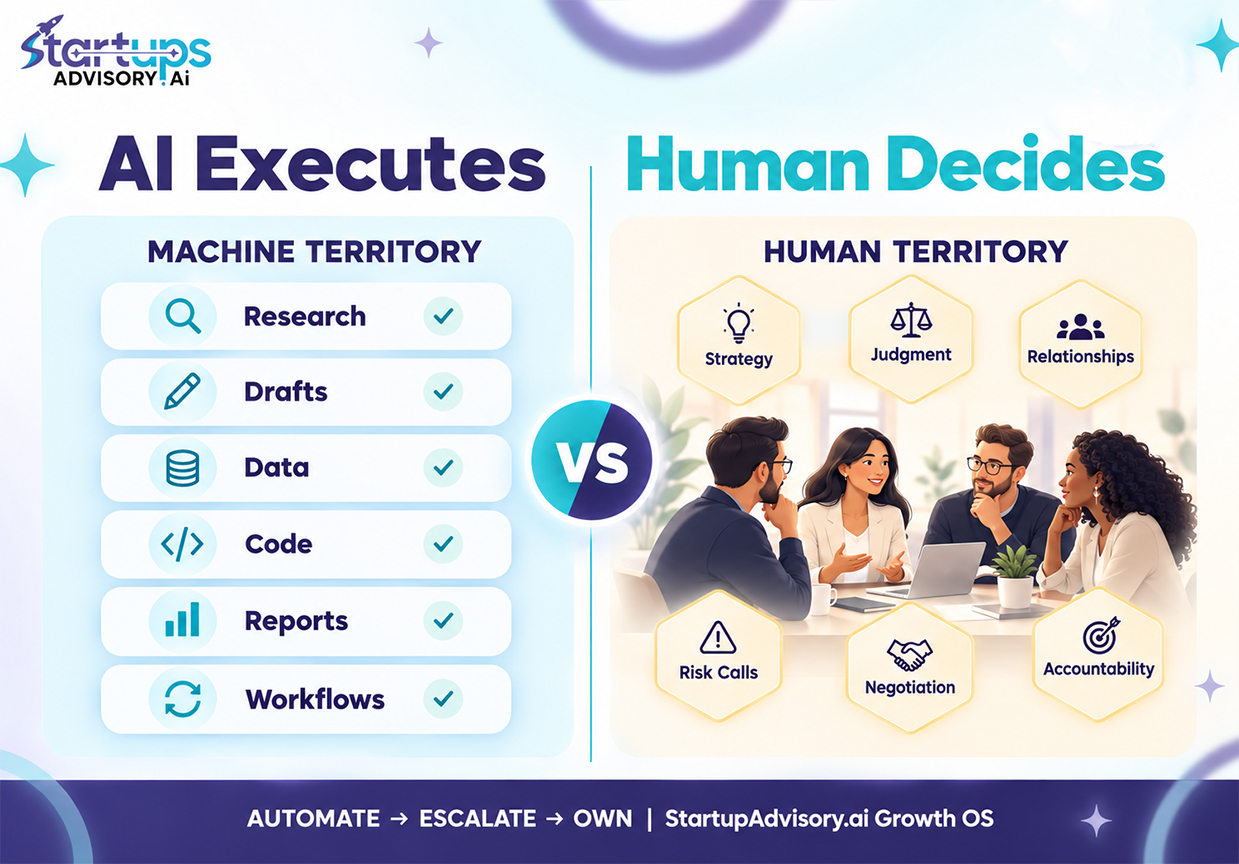
Where AI Helps — And Where Humans Step In
Imagine your AI support agent handles 95% of customer questions successfully.
A customer asks for a refund.
The AI follows policy and rejects the request.
Technically, it made the correct decision.
But a human leader sees something the system missed:
This customer has paid for three years, referred other customers, and represents a major relationship.
The best business decision is not always the one that follows the rule.
Sometimes it is the one that protects the relationship.
The Real Danger Is Not AI Mistakes. It Is Overconfidence.
Most businesses are not going to fail because AI produces obviously incorrect answers.
Those mistakes are easy to identify.
The bigger risk is an answer that looks professional, detailed, and reasonable but contains a hidden mistake.
AI can create confidence because it communicates clearly.
Clear communication does not always mean correct reasoning.
This creates a dangerous habit.
A team uses AI successfully many times.
Trust increases.
Eventually, people stop challenging the output.
The question changes from:
“Is this recommendation right?”
to:
“Why would this recommendation be wrong?”
That is the moment businesses need stronger human oversight.
The best AI users are not the companies that remove humans from every process.
They are the companies that know where human judgment creates the most value.
The AI Ownership Framework: Automate, Escalate, Own
Every AI workflow should answer three questions:
- What can AI handle independently?
- When should humans step in?
- Who owns the final outcome?
A practical model is:
Automate
Use AI for predictable tasks where results can be reviewed easily.
Examples:
- Research
- Reporting
- Content drafts
- Data organization
- Repetitive workflows
Escalate
Move decisions to people when situations become unusual, sensitive, or high impact.
Examples:
- Customer conflicts
- Strategic decisions
- Brand risks
- Complex negotiations
Own
Keep important outcomes connected to clear human responsibility.
Someone should always know:
- Who approved the decision
- Who reviews the result
- Who changes the process if something fails
Automation should reduce unnecessary work.
It should not create confusion about accountability.
Here is a practical way to apply that thinking:
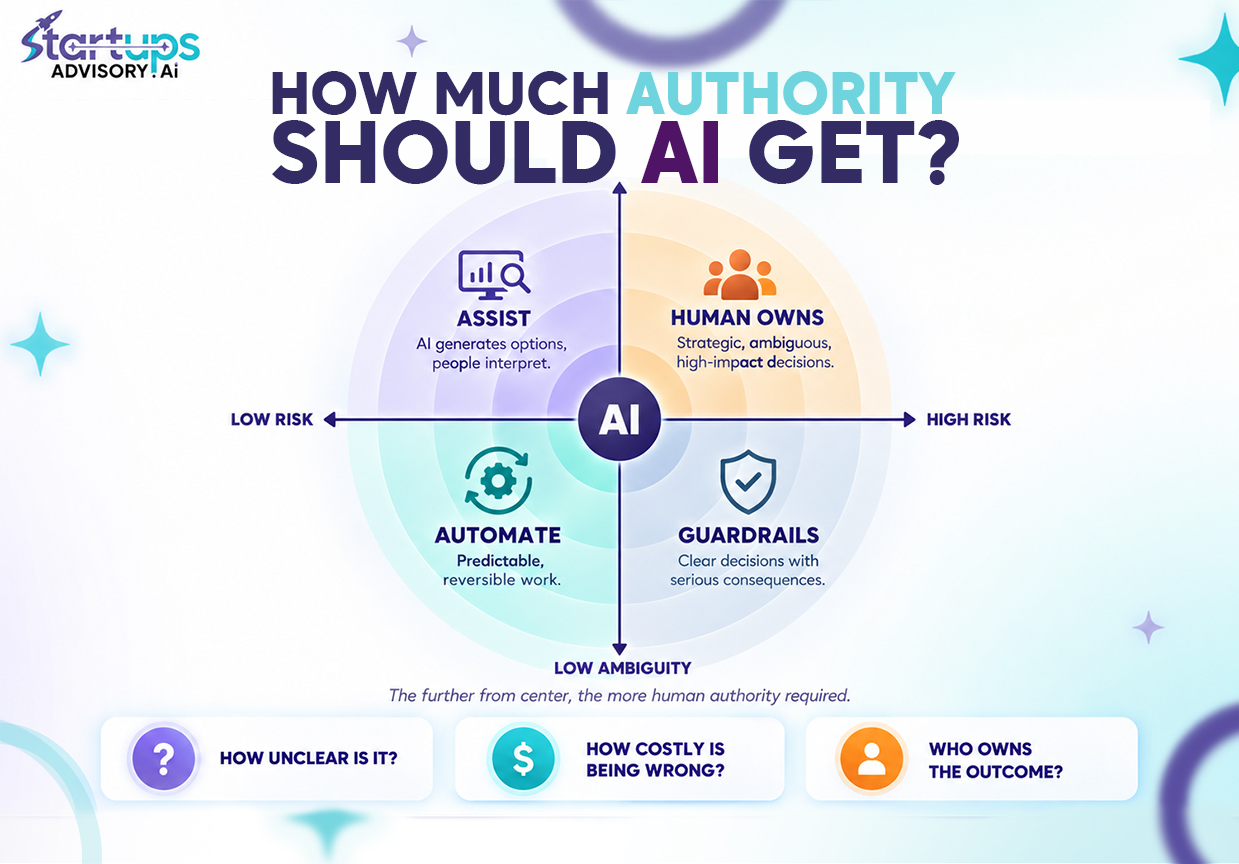
| Type of Decision | Best Role for AI | Best Role for People |
| Predictable and reversible | Automate and execute | Monitor exceptions |
| Clear but consequential | Recommend or act within limits | Set guardrails |
| Ambiguous but reversible | Research and generate options | Interpret and choose |
| Ambiguous and high impact | Analyze and support | Make and own the decision |
When Everyone Has AI, Execution Systems Become the Advantage
Soon, most companies will have access to similar AI capabilities.
Your competitors will use AI for marketing.
- They will automate workflows.
- They will generate content.
- They will analyze customer data.
The technology itself will become less of a differentiator.
Michael Porter famously wrote:
“The essence of strategy is choosing what not to do.”
This becomes even more relevant in an AI-driven world. When every company has access to powerful tools, the competitive advantage will not come from doing more things faster. It will come from knowing which opportunities deserve attention, which workflows should be automated, and which decisions require human judgment.
The advantage will come from the operating system around the technology.
Companies that win will know:
- What should be automated
- What requires human input
- How work moves between teams
- Who owns each outcome
This is why startups often struggle with AI adoption.
The problem is not access to tools.
The problem is turning tools into a reliable execution system.
The AI Execution Gap
Many companies believe AI adoption means buying the right tools.
It does not.
The real challenge is closing the gap between AI capability and business execution.
A company may have access to:
- AI assistants
- Automation platforms
- Data tools
- AI agents
- Content systems
But without clear workflows, ownership, and decision processes, those tools create activity instead of progress.
This is the AI Execution Gap.
- The technology can generate answers.
- The business still needs a system that turns those answers into action.
- The companies that win will not be the ones with the most AI tools.
They will be the ones that build the strongest operating systems around them.
Before Adding Another AI Tool, Ask These Questions
Before implementing another AI platform, ask:
- What decision will this improve?
If it only creates more output, it may not create more value.
- Who owns the result?
Every automated workflow needs a responsible owner.
- Where does human judgment remain necessary?
Not every decision should be automated.
- How will we measure success?
Speed alone is not enough.
Measure:
- Better decisions
- Faster execution
- Improved customer experience
- Reduced operational friction
Bridging the Execution Gap: The Growth OS Approach
Solving the AI execution gap requires moving beyond isolated tools. The goal isn’t to stack more software onto an already stretched team, but to build an integrated operating layer around your technology.
This is precisely why models like StartupAdvisory.ai’s Growth OS are emerging. Rather than forcing founders to act as the middleman between fragmented AI tools, strategic oversight, and execution, a unified operating system connects these pieces:
- Strategic Direction: Humans define the roadmap, guardrails, and key outcomes.
- AI Automation: Workflows handle predictable research, data organization, and routine content drafts.
- Specialized Execution: Expert teams step in to manage complex creative production, web experiences, and high-impact marketing where human nuance is critical.
The purpose of a modern execution system isn’t to replace decision-makers. It’s to clear away low-leverage coordination so leaders can focus exclusively on the high-stakes calls that define the business.
The Future Belongs to Human-Guided AI
AI will continue becoming smarter.
- It will analyze more information.
- Complete more tasks.
- Automate more workflows.
Businesses should embrace that.
But intelligence alone does not create a successful company.
Direction matters.
Context matters.
Accountability matters.
The future winners will not be businesses that ask AI to replace leadership.
They will be businesses that use AI to strengthen leadership.
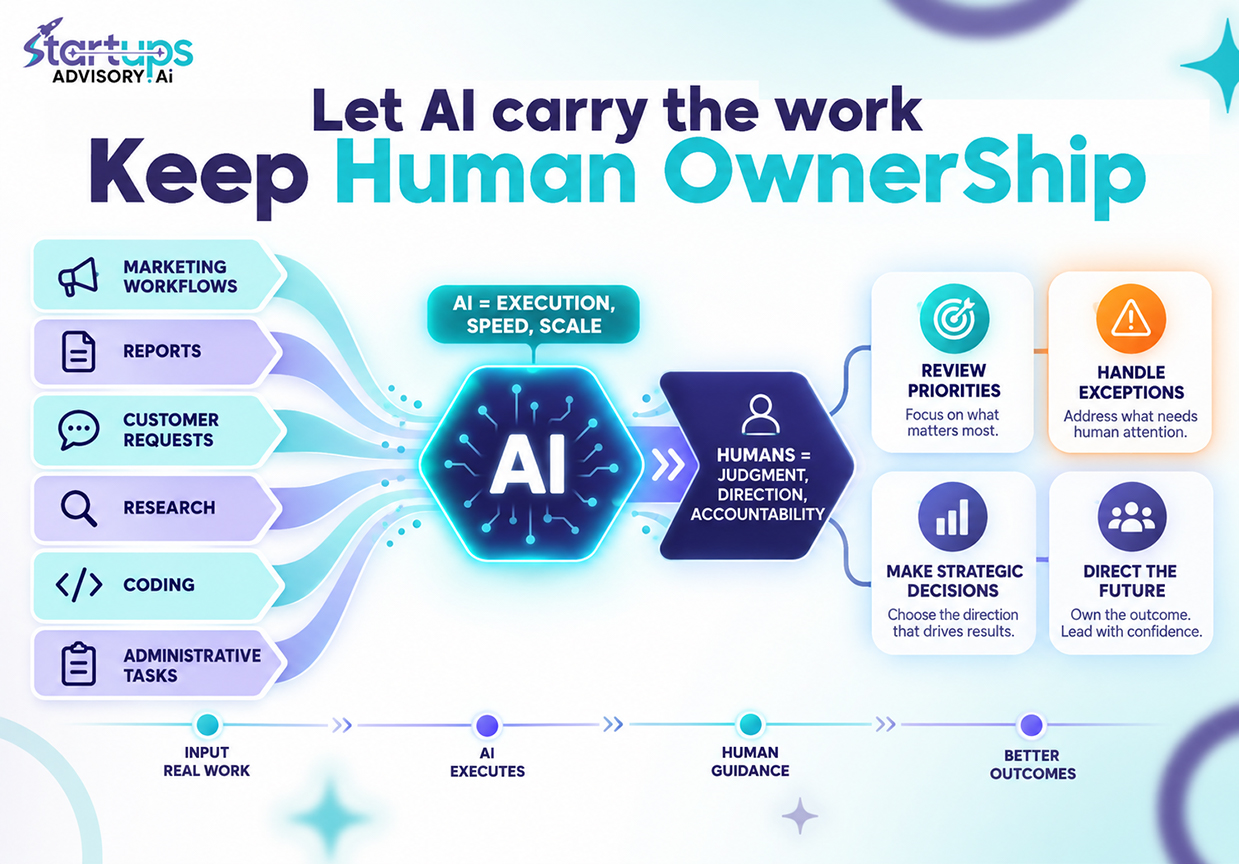
Let AI handle more of the work.
Let people handle the decisions that define the future.
Because the biggest advantage in an AI world will not be having the smartest tool.
It will be knowing what to do with it.
Ready to Build a Better AI-Powered Operating System?
If your business has more AI tools but you still spend your time coordinating tasks, chasing updates, and managing every detail, the problem may not be the technology.
It may be the system around it.
StartupAdvisory.ai helps startups create a stronger execution structure by combining strategy, specialized teams, and AI-powered workflows through its Growth OS approach.
The goal is simple:
- Use AI for speed.
- Use systems for execution.
- Use human judgment for decisions that matter.
If your team is managing more tools but experiencing slower execution, the issue isn’t your technology—it’s the system around it.
Schedule a strategy call with StartupAdvisory.ai. Combine strategy, specialized execution teams, and AI-powered workflows to scale without bottlenecks.
FAQs
1. What is the biggest limitation of AI in business?
AI can process information, generate outputs, and automate workflows, but it still struggles with context, uncertainty, and responsibility. Businesses need people who can interpret situations and make decisions when the answer is not obvious.
2. Can AI replace business leaders?
No. AI can support leaders by improving analysis, efficiency, and execution, but leadership still requires judgment, prioritization, relationship management, and accountability.
3. What tasks are best suited for AI automation?
AI works best for predictable, repetitive, and measurable tasks such as research, reporting, data organization, content assistance, and structured workflows.
4. Why does human judgment still matter with AI?
Many business decisions involve factors that cannot be measured only through data, including customer relationships, reputation, timing, risk, and long-term consequences.
5. Can AI make business decisions independently?
AI can support or automate certain low-risk decisions, but businesses should define clear limits and maintain human oversight for decisions involving significant impact.
6. What is the biggest risk of using AI in business?
The biggest risk is not always obvious mistakes. It is trusting AI outputs too quickly because they appear confident, logical, and well written even when important context is missing.
7. How should startups approach AI adoption?
Startups should focus on building systems around AI, not simply collecting tools. They need clear workflows, ownership rules, and processes that combine automation with human decision-making.
8. What is human AI collaboration?
Human AI collaboration means allowing AI to handle speed, analysis, and repetitive execution while people focus on strategy, creativity, relationships, and decisions requiring judgment.
9. How does StartupAdvisory.ai help startups use AI effectively?
StartupAdvisory.ai helps startups create stronger execution systems through its Growth OS approach, combining AI-powered workflows, strategic support, and specialist teams across areas such as marketing, design, web, video, social media, and automation.