You finish another sales call and feel like it went well.
The prospect asked questions. They understood the offer. They seemed interested.
Then the conversation ends with a sentence every founder knows:
“Send me the details, and we’ll get back to you.”
You send the follow-up. You wait.
Nothing.
The frustrating part is that you cannot always explain what went wrong. The prospect had a real problem. Your solution could help. The conversation felt positive. But the deal still disappeared.
Then another prospect comes along.
Same product. Same founder. Same market.
This time, they understand the value, move forward, and become a customer.
So what changed?
Usually, it is not your ability to sell.
It is the process behind the sale.
Early sales often depend on founder instinct. One prospect gets a full product walkthrough. Another gets a discount too early. Follow-ups happen when there is time. Every conversation is different.
That may work at the beginning, but instinct alone is difficult to repeat, improve, or eventually hand to someone else.
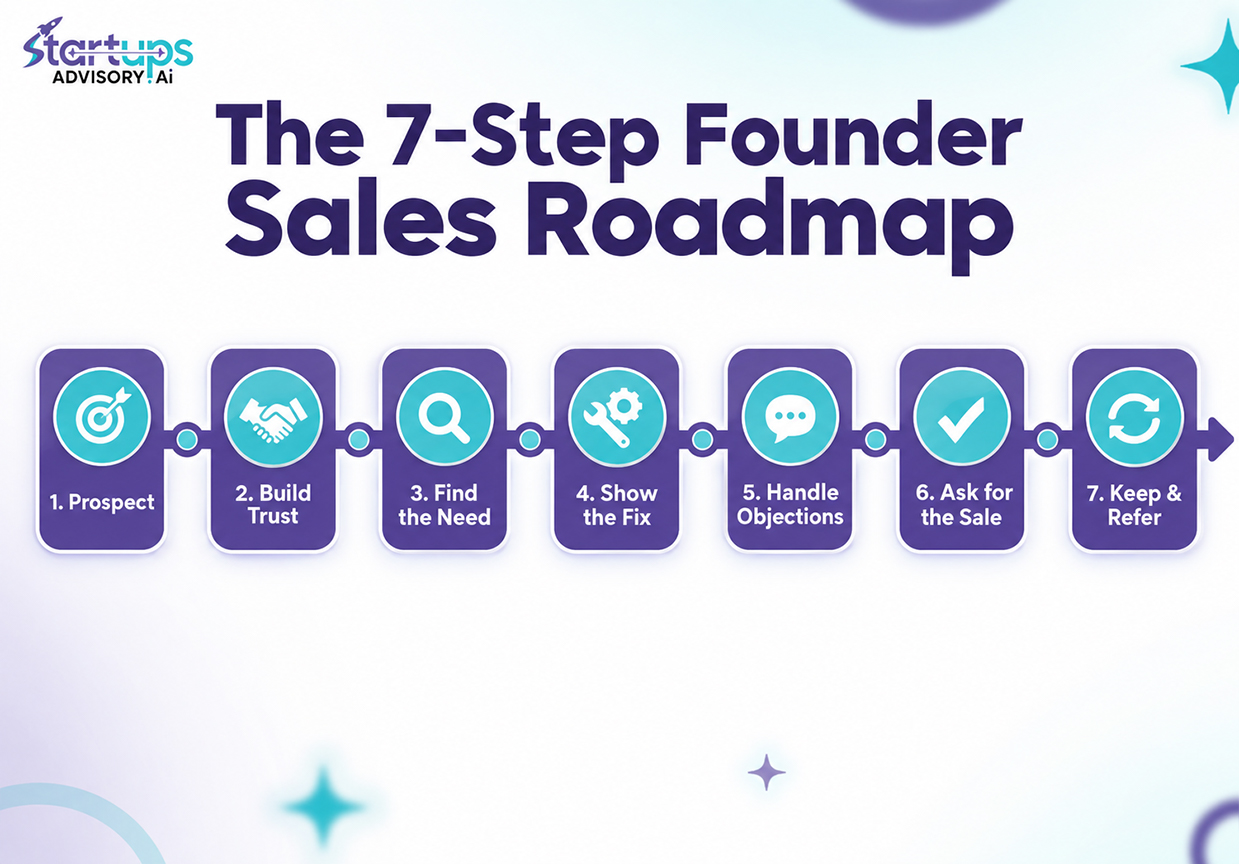
A sales process gives founders a clear path for moving the right buyer from first conversation to confident decision. It helps identify better prospects, build trust, uncover real needs, present the right solution, handle objections, close clearly, and create relationships that lead to repeat business and referrals.
The goal is not to force every prospect through a script.
The goal is to create better conversations — and a repeatable way to turn the right opportunities into customers.
Key Takeaways
- Prospecting starts with fit, not volume.
- Trust and discovery should happen before the full solution is presented.
- Objections are signals to understand, not arguments to win.
- The sale is not finished at “yes”; retention and referrals complete the process.
What Comes First: The Sales Process or the Sales Team?
You finally decide it is time to hire your first salesperson. You cannot keep taking every sales call, following up with every lead, and explaining the same product repeatedly.
So you hire someone.
Then the questions start:
‘Who exactly should I target?’
‘What should I say when someone says the price is too high?’
‘Which customers are actually the best fit?’
And that is when you realize something important:
You did not build a sales process. You built a sales habit.
Founder-led sales is valuable because the founder hears objections directly, learns the buyer’s language, sees what creates urgency, and discovers what people will pay for.
But those lessons disappear if they stay only in the founder’s head.
A repeatable process makes it possible to see whether deals are dying because leads are weak, discovery is shallow, the offer is unclear, objections are mishandled, or nobody actually asks for the sale.
That matters before hiring a salesperson. Handing over an unproven process is not delegation; it is transferring uncertainty. First learn what works. Then document it and make it teachable. The supplied founder-sales material makes the same practical point: prove a repeatable process before expecting another salesperson to carry it.
Modern buyers also punish sloppy prospecting. Gartner reported that 73% of B2B buyers actively avoid suppliers that send irrelevant outreach. More touches do not automatically create more opportunity. Relevance has to come first.
Step 1: Prospecting — Stop Chasing Everyone
Prospecting is not collecting the largest possible list of names.
It is finding people who are likely to have the problem, care enough to solve it, and have a realistic path to buying.
Before you add another name to your pipeline, ask yourself four questions: Does this company fit the customer profile? Is the problem real? Is there urgency? Can this person influence or make the decision?
Bad prospecting creates fake pipelines. Calendars look full, but most conversations were never going anywhere.
Good prospecting creates fewer, better conversations.
The first message should reflect that. Instead of opening with a company biography or a generic “We help businesses grow,” connect the outreach to a recognizable situation the prospect is already facing.
The goal is not to close in the first message.
It is to earn a relevant conversation.
The first step is finding better-qualified prospects who have a real need, fit the offer, and can realistically buy.
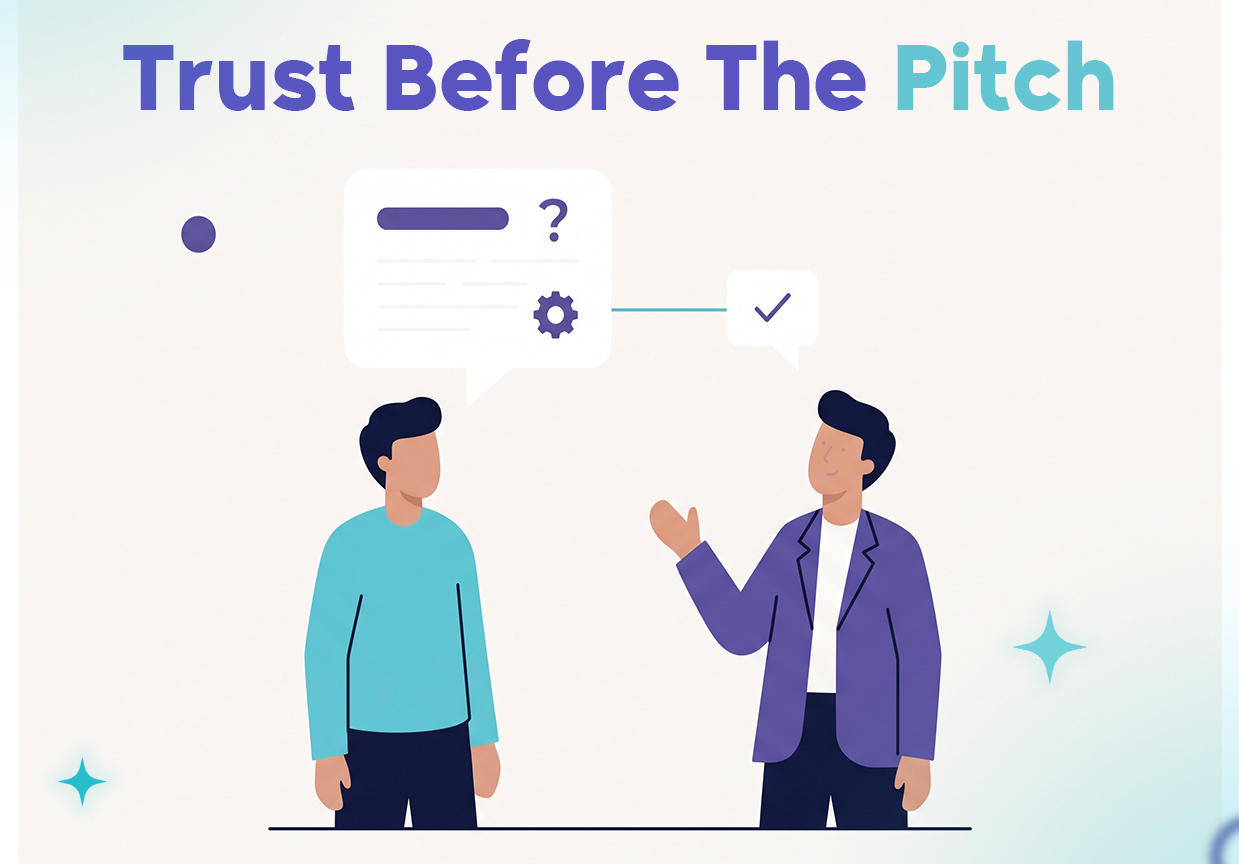
Step 2: Build Trust Before You Sell
Once a conversation starts, founders often rush to prove how much they know.
Trust usually grows in the opposite direction.
The prospect needs to feel understood before the founder tries to be understood. That means listening without interrupting, asking thoughtful follow-ups, being specific, and being willing to say when something is not a fit.
Trust and credibility belong near the beginning of the sales process because recommendations carry more weight once buyers feel understood.
Zig Ziglar captured the spirit of that approach:
“You can have everything in life you want if you will just help enough other people get what they want.”
For a founder, the objective becomes helping the right prospect make a good decision, not “winning” every call.
Trust does not require friendship. It requires enough credibility for the buyer to tell the truth.
Step 3: Find the Real Problem
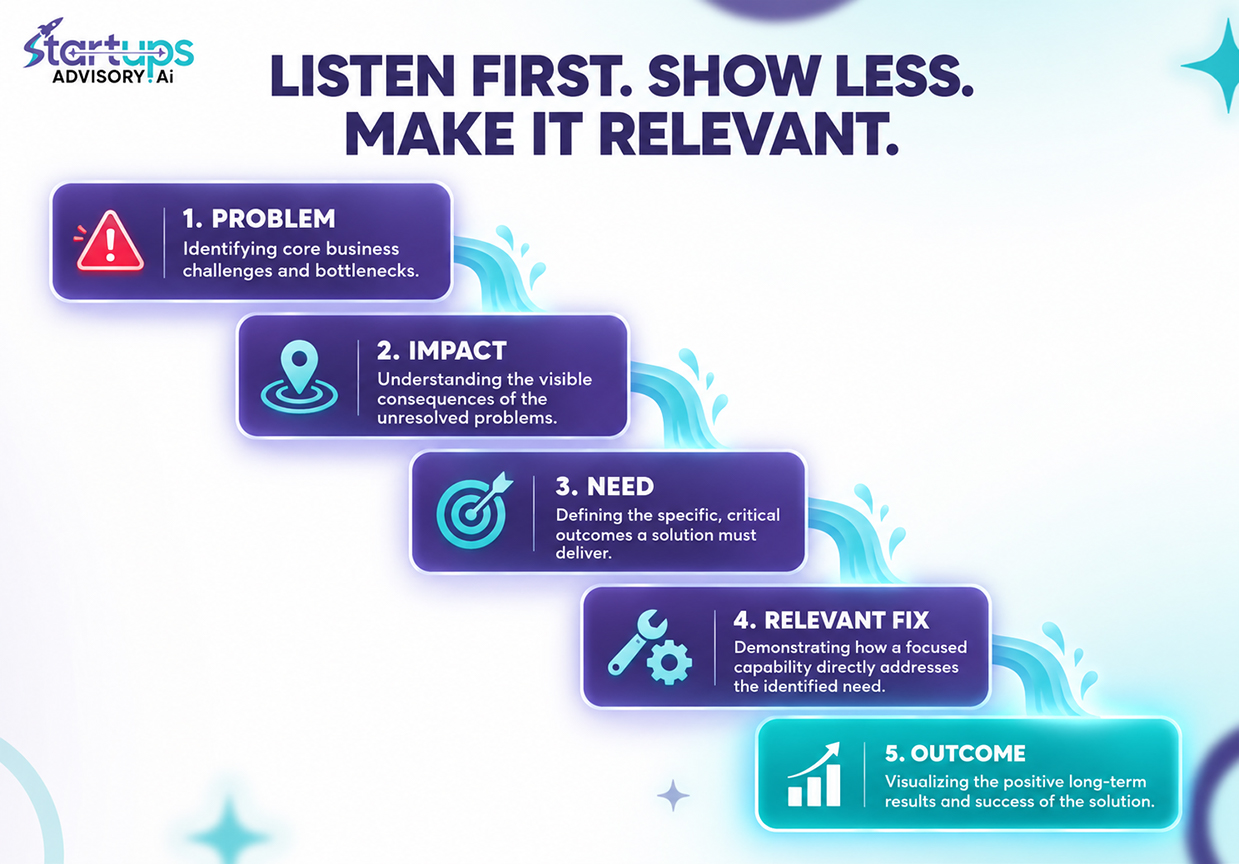
This is where a good sales conversation becomes diagnostic.
The founder knows the product, but not yet which part matters to this buyer.
Ask until the gap becomes clear:
- What is happening now?
- Where is the process breaking?
- What has already been tried?
- What happens if nothing changes?
- What would a better outcome look like?
The strongest discovery questions uncover both the problem and its consequence.
“Lead follow-up is inconsistent” is a problem.
“We are paying for leads that sit untouched for two days, and the owner keeps stepping in manually” is a buying problem.
The second version has impact, ownership, and urgency.
Discovery also protects the founder from selling the wrong solution. Sometimes the prospect needs a smaller offer. Sometimes the timing is wrong.
Finding that out early is qualification, not failure.
Step 4: Show the Fix, Not Everything
Once the need is clear, the presentation should get narrower, not bigger.
Founders are proud of what they built, so the temptation is to show every feature, integration, automation, report, and roadmap item.
The buyer is still thinking about the problem discussed five minutes ago.
A simple structure works:
You said: Restate the problem in the buyer’s language.
Here is what changes: Show the relevant part of the solution.
Here is why it matters: Tie it to time, capacity, revenue, risk, or another outcome the buyer already cares about.
If three capabilities solve the problem, show three.
A good presentation feels less like a product tour and more like the logical continuation of discovery.
Step 5: Objections Aren’t Rejection
Objections can feel personal when the founder created the product.
“It is too expensive.” “We need to think.” “We already use someone.” “The timing is wrong.”
The instinct may be to defend, discount, or talk faster.
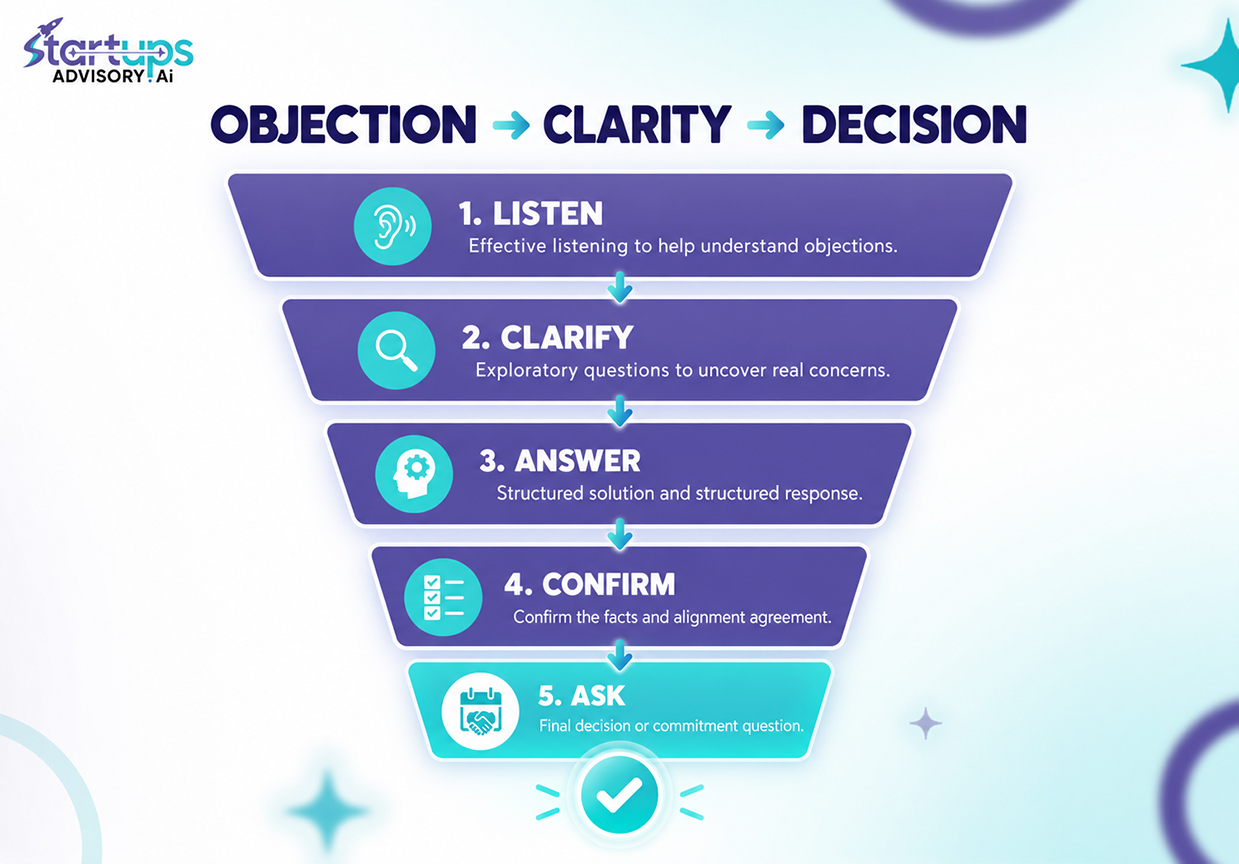
A better response is to diagnose again.
“Too expensive” may mean value is unclear. “Not now” may mean priority is weak. “We already have someone” may mean switching feels risky.
Instead:
- Listen without interrupting.
- Acknowledge the concern.
- Ask what specifically is creating hesitation.
- Answer the real issue.
- Check whether the concern is resolved.
The goal is not to defeat the objection.
It is to remove enough uncertainty for the buyer to make an informed decision.
Objections should be treated as concerns to understand and resolve rather than resistance to fight.
Step 6: Stop Hinting, Start Asking
Some founders do everything right and then avoid the most obvious step.
They never ask.
They finish the demo, answer questions, share pricing, and end with:
“I’ll send this over and you can let me know.”
That creates ambiguity exactly when the conversation needs clarity.
If the prospect is qualified, the need is clear, the solution fits, and the major concerns are answered, asking for a decision is simply the next step.
Try:
“Based on what we discussed, does it make sense to move forward?”
Or:
“Is there anything still stopping us from getting started?”
A “no” is useful information. A “not yet” can reveal the missing condition. A “yes” creates the next action.
Closing is the point where the founder confidently asks the prospect to make a decision and take the next step.
Step 7: Keep Them Coming Back
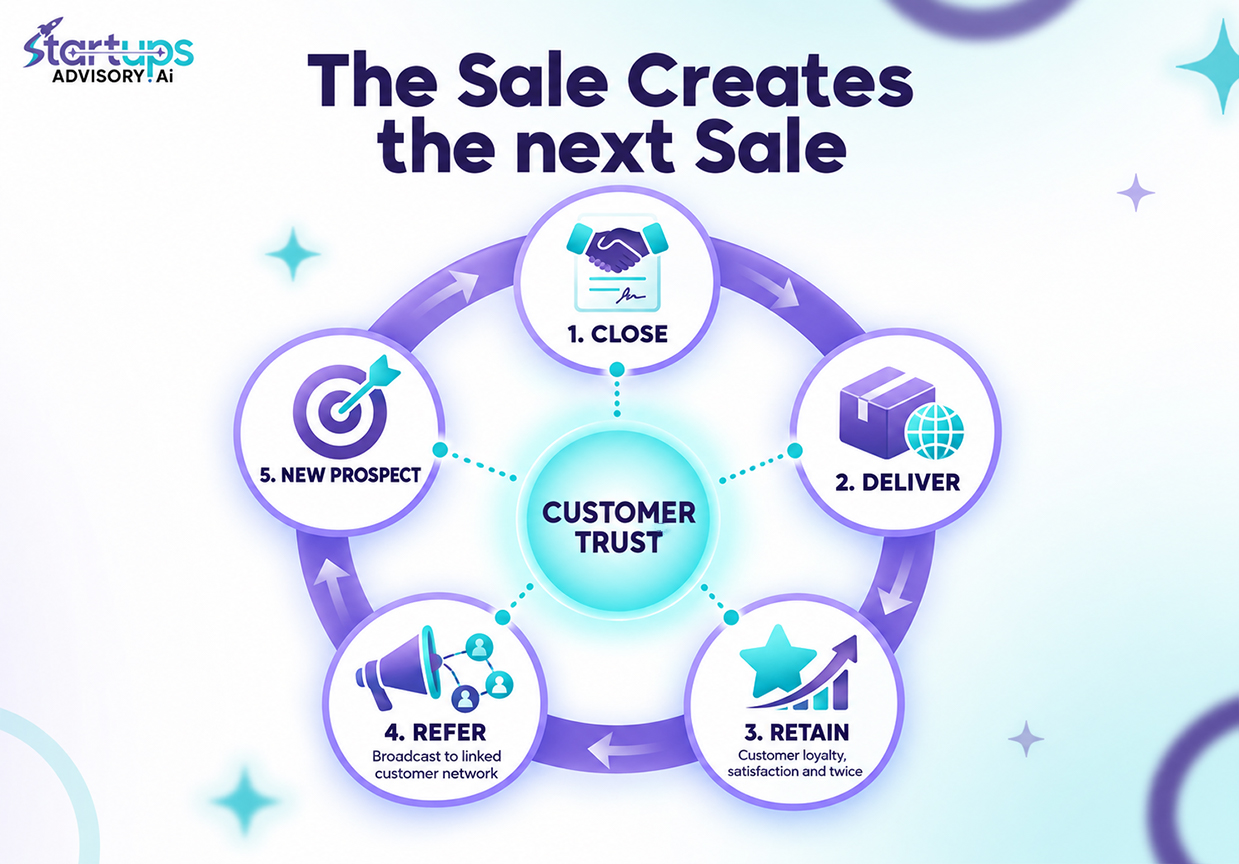
A closed deal is not the end of the sales process.
It is where the business gets the chance to prove that everything promised during the sale was real.
Onboard well, catch friction early, deliver the outcome, and continue the relationship after payment.
When customers feel taken care of, they are more likely to stay, buy again when another need appears, and introduce others.
That is why repeat sales and referrals belong inside the sales process rather than being treated as something that happens after it ends.
Make this operational. Decide who checks in, when success is reviewed, how feedback is captured, and when a referral is appropriate to request.
A referral earned through a strong experience enters the next sales cycle with something cold outreach has to build from scratch:
borrowed trust.
What Is the Buyer Really Deciding at Each Step?
A sales process works best when the founder understands what is happening on the buyer’s side of the conversation. Each stage should answer a different question in the prospect’s mind.
| Sales Stage | What the Buyer Is Thinking | Founder’s Job |
| Prospect | “Is this relevant to me?” | Target people with a real problem, fit, urgency, and ability to buy. |
| Build Trust | “Do I believe this person understands me?” | Listen, communicate clearly, and establish credibility without overpitching. |
| Find the Need | “Do they actually understand what is wrong?” | Ask questions until the problem, impact, and desired outcome are clear. |
| Show the Fix | “Can this realistically solve my problem?” | Connect only the most relevant capabilities to the buyer’s stated needs. |
| Handle Objections | “What could go wrong if I say yes?” | Surface the real concern, reduce uncertainty, and answer it directly. |
| Ask for the Sale | “Am I ready to make this decision?” | Confirm alignment and clearly ask for the next commitment. |
| Keep & Refer | “Was choosing this company the right decision?” | Deliver well, maintain the relationship, and earn repeat business and referrals. |
The founder does not need to push the buyer through these stages faster than they are ready to move. The goal is to understand which decision is still unresolved and help the prospect reach clarity.
What Separates a Strong Sales Call From a Weak One?
A process becomes useful when it tells the founder what to do differently, not just what stage a deal is in.
| Do This | Not This |
| Qualify before pitching. Spend time where the problem, fit, and buying ability are real. | Do not treat every lead like an opportunity. A busy pipeline can still be weak. |
| Ask, listen, then present. Let discovery decide what the buyer needs to see. | Do not dump every feature into the call. More information can make the decision harder. |
| Clarify objections and ask for a decision. Keep the next step explicit. | Do not discount the first pushback or end with “let me know.” Both avoid the real conversation. |
The pattern underneath all three mistakes is the same: the founder starts managing personal anxiety instead of managing the buyer’s decision.
How Does a Founder Turn “Maybe” Into “Yes”?
Consider a familiar scenario: a founder sells a service that helps local businesses generate and follow up with leads.
A restaurant owner replies to outreach.
The inexperienced version immediately sends a deck explaining ads, landing pages, CRM automation, content, reporting, and AI follow-up.
The structured version behaves differently.
First, the founder confirms the restaurant is actively trying to increase bookings and has budget to improve acquisition. Then they discuss the current process instead of pushing a package.
Discovery reveals the real problem: leads are coming in, but staff are busy during service, so inquiries sit unanswered. More advertising would increase volume without fixing response time.
Now the presentation becomes simple. The founder shows how the service can capture inquiries, organize them, and create consistent follow-up.
The owner objects:
“We already spend enough on marketing.”
Instead of discounting, the founder asks whether the concern is total spend or paying for another system without knowing whether it will recover missed opportunities.
That opens a better conversation about value.
Once the concern is addressed, the founder asks whether the owner wants to move forward.
After the sale, the process continues through onboarding, check-ins, feedback, and eventually a referral request if the outcome is strong.
Same offer.
Very different sales experience.
Turn Founder Instinct Into a Sales System
The seven steps matter even more once the founder wants to stop being the only person who can sell.
The first goal is not a giant sales manual.
It is a lightweight operating system.
For each stage, document:
- What must be true before a deal moves forward
- The key questions that should be answered
- The common reasons deals stall
- The proof or material that helps
- The next action and who owns it
Then review real deals.
If prospects disappear after discovery, the team may not be finding enough urgency. If proposals stall, the value may be unclear. If objections repeatedly center on price, the problem may have started with weak qualification or a presentation disconnected from the buyer’s priorities.
This turns sales from personality into feedback.
The founder still brings judgment, empathy, and creativity. The process makes those strengths easier to repeat and eventually transfer.
That is when founder-led sales becomes a company capability instead of another job the founder can never escape.
This is also where many founders reach the next challenge: they understand what needs to happen, but they do not always have the time, team, or specialized support to build every part of the growth system themselves.
A repeatable sales process is only one part of growth. Consistent execution across marketing, automation, customer acquisition, and operations is what turns a process into a scalable system.
Conclusion: Stop Pitching. Start Moving the Buyer Forward.
The best sales process does not make a founder sound more scripted.
It makes the conversation more relevant.
Prospect the right people. Build enough trust for an honest conversation. Understand the real need. Show the part of the solution that matters. Treat objections as information. Ask clearly for the decision. Then deliver well enough that customers stay and introduce the next one.
That is how “maybe” moves toward “sold” without turning the founder into a pressure salesperson.
More importantly, it creates something the business can improve, measure, document, and eventually delegate.
Revenue may begin with the founder making the sale.
Scale begins when the company understands how that sale gets made.
For founders who want sales execution, marketing, specialist support, automation, and accountability working inside one repeatable growth system, Startups Advisory helps reduce scattered execution and move founders back toward higher-leverage CEO work. Visit startupsadvisory.ai, email hello@startupadvisory.ai, or call +1 877 408 1285.
Frequently Asked Questions
What makes a good sales process?
A good sales process gives each stage a clear purpose, keeps the buyer’s needs at the center, defines the next action, and is flexible enough to adapt to different conversations.
Why do founders struggle to delegate sales?
Founders struggle to delegate because early sales rely on founder intuition, unwritten market knowledge, and flexible pitches. Without a documented, repeatable process, hiring a salesperson transfers uncertainty rather than delegating a proven system.
Why do prospects disappear after a good sales call?
Prospects usually disappear when discovery is too shallow to establish real financial or operational impact, the solution isn’t explicitly connected to their immediate pain point, or the call ends without an explicit, agreed-upon next step.
When should a startup hire its first salesperson?
A founder should ideally establish enough repeatability to show another seller who the right buyer is, what questions matter, what commonly stalls deals, and how an opportunity normally progresses. The source material similarly recommends creating a repeatable process before handing sales off.
What is the biggest mistake founders make when selling?
One of the biggest is pitching too early. When a founder presents the full product before understanding the buyer’s actual need, the conversation becomes feature-heavy instead of relevant.